What Are "Soulbound" Tokens (SBTs) in Education?
 Author:
 Reading time:
12 min
Reading time:
12 min
 Difficulty:
Easy
Difficulty:
Easy
Have you ever looked at your hard-earned diploma and wondered how easily that piece of paper could be forged? Even a basic PDF feels risky, often getting lost in a sea of bureaucracy. It’s a bit of an unsettling thought, isn't it?
Our digital lives are rapidly becoming our primary reality, so proving your identity shouldn't feel like a clunky relic from the past. This applies to your achievements, too. This is exactly where Soulbound Tokens (SBTs) in education come into play.
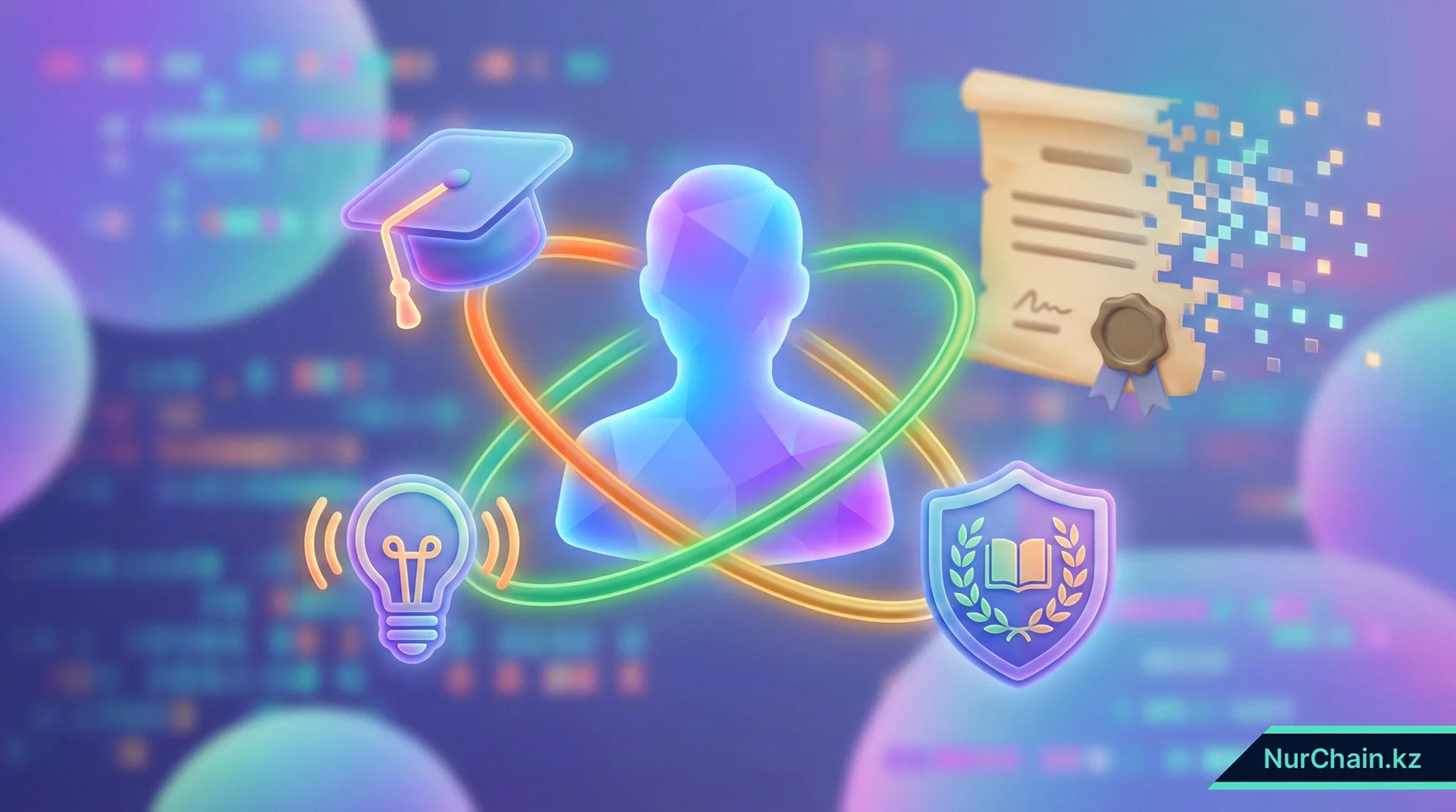
Think of these tokens as a revolutionary shift in how we handle blockchain academic identity . Essentially, they create a digital persona verified by blockchain technology. These are strictly non-transferable digital credentials . Unlike Bitcoin or those flashy, tradable NFTs people flip for profit, you can't sell these.
Instead, they are permanently tied to your private digital wallet-what the blockchain world often calls a "Soul." This system is a strategic response to global credential fraud , directly tackling the act of falsifying academic achievements. Here is the bottom line: SBTs create a vital social layer for the internet where your reputation and hard-earned skills cannot be bought or sold.
In this article, we’ll explore the core concept of SBTs and how they are virtually ending resume fraud. They achieve this through cryptographic verification , which is just a high-tech way of using mathematical algorithms to prove authenticity. We’ll also look at countries like Kazakhstan that are already leading the charge in this $22 billion EdTech revolution, guided by a strategic 10-year roadmap for digital education.
🏗️ Soulbound Tokens represent the foundational technology required to move The Future of EdTech in Kazakhstan from simple digital files to a permanent, non-transferable identity system.
The Concept of Non-Transferable Academic Identity
Imagine a digital certificate so uniquely yours that it cannot be sold, traded, or even moved to another person’s account. What exactly are SBTs in EdTech and why is everyone suddenly talking about them? This concept isn't just a futuristic dream-it is the actual foundation of what we call "Soulbound" Tokens (SBTs). They represent a permanent blockchain academic identity , paving the way for the future of decentralized academic transcripts that stay with you for life. Ethereum co-founder Vitalik Buterin, economist E. Glen Weyl, and lawyer Puja Ohlhaver first introduced these tokens in a May 2022 white paper titled " Decentralized Society: Finding Web3's Soul "; they designed them to build a Decentralized Society (DeSoc) (a framework for a social layer on the blockchain that relies on non-transferable relationships and trust). The authors argue that "the economic value of the internet is largely driven by human relationships," and SBTs serve as the essential social layer by representing "commitments, credentials, and affiliations" that no one can turn into tradable financial assets. While we usually think of blockchain as a way to trade assets like Bitcoin, SBTs function as strictly non-transferable digital credentials. Unlike traditional digital assets, can Soulbound Tokens be transferred or sold? The answer is a firm no; they are strictly non-tradable educational tokens designed to represent you , not a price tag. They live in a private, permanent blockchain wallet known as a "Soul" (a unique digital account that holds a person's non-tradable tokens). This technology arrives at the perfect time, as the global blockchain in EduTech market is set to grow at a CAGR (Compound Annual Growth Rate) (the mean annual growth rate of an investment over a specified period of time longer than one year) of 25.01%, eventually reaching a massive $22.31 billion by 2035.
What is the difference between NFTs and Soulbound Tokens? While both live on the blockchain, you trade or sell NFTs for profit, whereas Soulbound Tokens in education stay personal and permanent. In our current educational landscape, your "Soul" is basically your digital identity, where each SBT acts as a rock-solid, verifiable record of your hard work. How do Soulbound Tokens work in education? The institution "mints" (creates or issues) the token directly to your wallet, creating a link that no one can ever sever. Whether it is a university master's degree or a specific micro-credential or nanodegree, these tokens fit perfectly into a broader verifiable credentials market that should reach $11.1 billion by 2033. Because you cannot buy or swap these tokens, they preserve the absolute integrity (the quality of being honest and having strong moral principles) of your personal history. This development is crucial, especially since digital education users should reach 1 billion by 2028. By embracing Self-Sovereign Identity (SSI) (a model that gives individuals full control over their own digital identities without relying on central authorities), you-the student, not the school-gain ultimate ownership of your data. This makes it easier than ever to move between jobs and countries in our globalized market.
Why It Matters: Think of an SBT as a digital "tattoo" for your professional identity. It proves who you are and what you have achieved without the risk of someone else claiming your hard-earned success.

How SBTs Solve the Crisis of Credential Fraud
We have all heard the stories of "embellished" resumes, but the reality is much more widespread than you might think. Recent research shows that 1 in 3 workers (33%) admit to lying on their resumes, while 44% of job seekers confess to misrepresenting their actual skills or experience during the hiring process. This alarming trend is even more clear in the 2026 TransUnion Global Fraud Trends Report. That report identifies "synthetic identities"-the mixing of real and fake data-as a primary threat, noting that UK businesses lose an average of 7.4% of their annual revenue to these deceptive practices. This is not just a minor annoyance; it is a major financial drain. In the UK alone, recruitment fraud costs the economy an estimated £23.9 billion ($30 billion) annually , largely because manual verification is slow and companies occasionally hire the wrong people.
So, how do SBTs prevent resume fraud? By creating a system where achievements are verified at the source, we effectively automate digital diploma fraud prevention (the active blocking of counterfeit academic documentation) for every HR department. This is where the power of the blockchain comes in. By issuing degrees as SBTs, prestigious institutions like MIT, Harvard, and UC Berkeley are creating a "single source of truth"-a centralized, undisputed record that everyone can trust. Instead of a recruiter spending weeks calling registrars, they can perform a cryptographic verification in under one second. Because the data is immutable, once a degree is "minted" to your Soul, it is impossible to alter or forge. Recent pilot studies have actually shown 100% fraud detection rates. Beyond security, this shift is a massive win for efficiency; it can reduce university administrative costs by up to 90% by eliminating paper records. This is a game-changer for the $36.2 billion higher education technology market.
Quick Insight: When verification happens in less than a second, the "trust gap" in hiring disappears. Employers get the certainty they need, and honest candidates get the jobs they deserve without the wait.

Beyond Digital Diplomas: Building a Lifelong Educational "Soul"
A college degree is a big deal, but it rarely tells your whole story. SBTs allow you to tokenize micro-credentials and soft skills-like leadership or communication-that a traditional one-page diploma simply ignores. This synergy between micro-credentials and SBTs builds a much more detailed professional profile than a single degree ever could. This granular view is quickly becoming the new standard, especially with 75% of K-12 organizations projected to adopt Learning Management Systems (LMS) by 2025. You could even maintain multiple "Souls"-perhaps an "Education Soul" for formal degrees and a "Credential Soul" for professional certifications. This reflects a world where mobile learning is growing at 28.9% annually.
When we talk about Self-Sovereign Identity (SSI) for students, we are looking at a future where you have total control over your own records. What are the benefits of Self-Sovereign Identity for graduates? Beyond security, it offers you the freedom to share specific proofs without needing permission from your old university every single time you apply for a job. We are also seeing the rise of Proof of Attendance Protocols (POAP) , which are digital badges that prove you attended a specific event, whether it was virtual or in person. Imagine attending a workshop or a community event and receiving an unalterable token that proves you were there. European pilot programs have already issued over 32,000 digital credentials using this model.
Worried about losing your data? Future systems will include social recovery mechanisms , where a network of "guardians"-like trusted peers or institutions-can help you regain access if you lose your private keys. Best of all, this technology is designed to be GDPR-compliant and meet the strictest privacy standards. By using Zero-Knowledge Proofs (ZKPs) , you can prove you have a specific degree without actually revealing sensitive personal details. How do zero-knowledge proofs protect student privacy? They allow you to prove you have a passing grade or a specific skill while keeping the rest of your transcript hidden from prying eyes. It is no wonder that 66% of EdTech efforts are now focused entirely on further enhancing the student experience.
Takeaway: Your educational identity is more than a piece of paper; it is a lifelong journey. SBTs ensure that every seminar, workshop, and skill you pick up along the way is captured and stays with you forever.

Implementation in Kazakhstan’s Digital Transformation Strategy
Kazakhstan is rapidly carving out its spot as a regional leader. The Soulbound Tokens Kazakhstan digital transformation -our nationwide shift toward blockchain-based identity-ensures the country’s human capital stays backed by world-class tech. You can see the results of modernization programs like the "Accelerated Industrial and Innovative Development" plan: the country hit 100% LMS implementation across its universities by 2023. In January 2026, President Kassym-Jomart Tokayev accelerated this momentum by signing a decree declaring the "Year of Digitalization and Artificial Intelligence," highlighting the synergy of AI and blockchain in higher education-a strategic initiative where the newly empowered Ministry of Artificial Intelligence and Digital Development integrates secure digital ledger solutions, like blockchain, across the public sector. This creates the perfect environment for SBTs to thrive. You might ask, how is Kazakhstan using blockchain for university degrees? By weaving these tokens into the national education ecosystem, the government ensures compliance with global digital credential standards, making academic records instantly verifiable across borders. Trusted national platforms like Kundelik, Platonus, and Smart University are perfectly positioned to bridge the digital divide. Right now, national universities show a digital readiness score of 4.2 out of 5, clearly outperforming private institutions at 3.1.
For you as a graduate in Kazakhstan, switching to SBTs means better global mobility , giving you the freedom to work across international borders with ease. Statistics show a strong positive correlation ()-meaning these two factors move closely together-between digital technology use and the overall quality of education in regional studies. By providing permanent, equal access to high-quality digital records, Kazakhstan ensures that students in rural areas aren't left behind as AI-driven tools become common. Furthermore, as the Ministry of Science and Higher Education pushes for more transparency and objectivity in grading, SBTs offer a tamper-proof way to record assessments for everyone. This shift aligns perfectly with the 2026 digital competency frameworks (the skills you need for the modern workforce) and the skills wallet concept, effectively ensuring that Kazakhstani students are ready for the global stage.
Did You Know?: Kazakhstan’s high digital readiness in national universities puts the country ahead of many neighbors, making secure, blockchain-based graduation a reality for its students today.

Summary: SBTs and the Dawn of a Permanent, Fraud-Proof Academic Identity
We are witnessing a fundamental shift right now. The rise of Soulbound Tokens (SBTs) pulls us away from tradable digital assets and toward a permanent, non-financial social layer on the blockchain.
What are SBTs in EdTech exactly? They go far beyond just "locked" or restricted NFTs; these tokens serve as the cornerstone of a Decentralized Society (DeSoc) where you own your data without any central authority.
Since these non-tradable educational tokens stay with you forever, your blockchain academic identity remains tethered to the person who earned it. The bottom line? This preserves the integrity of your achievements by ensuring honesty-and strong moral principles-are baked into the system.
This technology addresses a tough reality: one in three workers admit to lying on their resumes. SBTs provide a "single source of truth" that allows employers to perform cryptographic verification in under a second.
Your records are now immutable -which is just a fancy way of saying they can't be changed. Prestigious institutions like MIT and Harvard already use this tech to automate digital diploma fraud prevention , turning weeks of administrative hurdles into a seamless interaction.
Now, look at the powerful synergy between micro-credentials and SBTs . This gives you a "granular" view of your lifelong learning journey, meaning it captures every specific detail from soft skills to workshop attendance via Proof of Attendance Protocols (POAP) . These are the digital badges that prove you were actually there.
This transition to Self-Sovereign Identity (SSI) for students is vital because it puts you in full control of your digital identity. It places the power back in your hands as a graduate, allowing you to manage your own data while maintaining strict GDPR compliance .
You can even achieve this through Zero-Knowledge Proofs (ZKPs) -technology that proves you have specific information without actually revealing the data itself. We see this vision taking flight right now in the Soulbound Tokens Kazakhstan digital transformation , which is backed by government decrees.
The initiative integrates these tokens into national frameworks to foster global mobility , or the ability to have your credentials recognized anywhere. Ultimately, SBTs transform a qualification from a static document into a living, verifiable digital "tattoo" that paves the way for a more honest and efficient global workforce.
🧠 Now that you know the basics: If SBTs are the individual building blocks of your identity, how do they come together to form a complete, verifiable record? Explore The Future of Decentralized Academic Transcripts to see the full ecosystem in action.
