Strategic Benefits of NFT Diplomas for Universities in Kazakhstan (Overview)
 Author:
 Reading time:
18 min
Reading time:
18 min
 Difficulty:
Easy
Difficulty:
Easy
- Elevating Global Prestige Through Verified Innovation
- Turning Kazakhstan into a Global Magnet for Tech-Savvy Students
- Reducing University Administrative Costs with Blockchain Diplomas
- Reclaiming Trust: How NFTs End the Era of Fake Degrees
- How NFT Diplomas Align with "Digital Kazakhstan" Program KPIs
- How NFT Diplomas Transform Graduation into a Lifelong Connection
- The Value of Instant Global Verification for Kazakhstani Graduates
- Gaining Competitive Advantage: NFT Diplomas in the Kazakhstani Education Market
- The Environmental Impact: Why Digital is the Green Standard
- Turning Graduation Data into a Strategic Success Map
- Summary: Transforming Kazakhstani Higher Education into a Global Digital Powerhouse
Have you ever looked at a stack of paper diplomas and seen more than just academic achievements? Let's be honest, you might be seeing a mountain of administrative headaches and security risks instead. We are currently in an era where a $22 billion fake degree market is actively growing. This global industry of counterfeit educational credentials is a serious threat to institutional prestige. Sticking to traditional paper is like trying to navigate a digital-first economy with a tattered paper map. It’s a bit outdated, right?
NFT diplomas offer a strategic shift for Kazakhstan’s higher education. They provide a blockchain-backed "academic passport" that ensures instant, global verification. At the same time, this technology helps with slashing operational costs. This move isn't just about replacing paper. Instead, it’s about positioning your institution as a modern, tech-forward leader. This is vital in an increasingly competitive global market. What's important to remember is how these digital assets boost university rankings. They also help attract tech-savvy international students. Furthermore, they align with the national "Digital Kazakhstan 2026" vision. This is the government initiative for digital transformation. We're talking about transforming your institution’s degrees into lifelong, portable assets. These are assets that students can carry with them anywhere.
Elevating Global Prestige Through Verified Innovation
Climbing the global university rankings often feels like chasing a moving target. You’ve seen how much weight is placed on "reputation," but how do you actually influence something so abstract? Every ambitious administrator faces this challenge, especially as paper-based systems fail to keep up with a digital-first world.
Here is why that matters. Your institution’s standing is currently tied to a vulnerable verification process. With the global counterfeit diploma market now valued at a staggering $22 billion, trust is a premium currency. Providing a "single source of truth" through NFT diplomas isn't just a tech upgrade-it’s a massive strategic lever. By using blockchain-backed credentials, you directly improve your Employer Reputation metric , which accounts for 15% of the total QS World University Ranking score.
The bottom line is that you're giving your graduates an "academic passport" for instant, cryptographic verification. Instead of recruiters waiting weeks for a registrar's confirmation, they get 100% certainty in seconds. This level of transparency signals deep EdTech innovation to your peers, which helps boost your Academic Reputation -a category that carries 30% of your total ranking weight.
Beyond the prestige, you have a powerful sustainability story to tell. Shifting to digital slashes the CO2 footprint of your graduation documents by up to 95%, helping you hit the vital ESG targets that modern ranking bodies now track. It proves your university isn't just teaching the future-you're actively building it .
To see the full breakdown of how these digital assets influence specific ranking weights and to learn how to position your institution as a global leader, explore our detailed guide on strategies to boost your global university ranking.

Turning Kazakhstan into a Global Magnet for Tech-Savvy Students
For international students, a traditional diploma often feels like a "paper wall." Between expensive apostilles and verification processes that drag on for months, the path to a global career stays unnecessarily bumpy. You've likely seen how frustrating that bureaucracy can be, but things are shifting fast.
Kazakhstan is currently transforming into a premier digital education hub for Central Asia. This isn't just about moving files to the cloud; it’s a complete reimagining of the student experience. By embracing NFT diplomas, universities offer something far more valuable than a piece of paper: unshakeable data sovereignty. What this means in practice is a shift toward Self-Sovereign Identity (SSI) . Instead of being a "data subject" buried in a university database, the student becomes the sole owner of their academic records. Here is the reason why this matters-by using "future-proof" technology, institutions solve two of the biggest headaches in global education:
- The Trust Gap: With digital document forgeries spiking by over 244% recently, an NFT acts as a tamper-proof digital passport that is impossible to fake.
- The Verification Lag: Employers can verify credentials in seconds rather than weeks, giving graduates a massive head start in the global job market.
The bottom line? By aligning with the national "Year of Digitalization" in 2026, Kazakhstani institutions are finally speaking the language of a mobile-first generation. This digital-first mindset is exactly why we're seeing such a surge in interest from major markets like India and China. To see the data behind this growth and explore the full strategy for building a student-centric ecosystem, learn how NFT diplomas are breaking down the "paper wall" for international students.

Reducing University Administrative Costs with Blockchain Diplomas
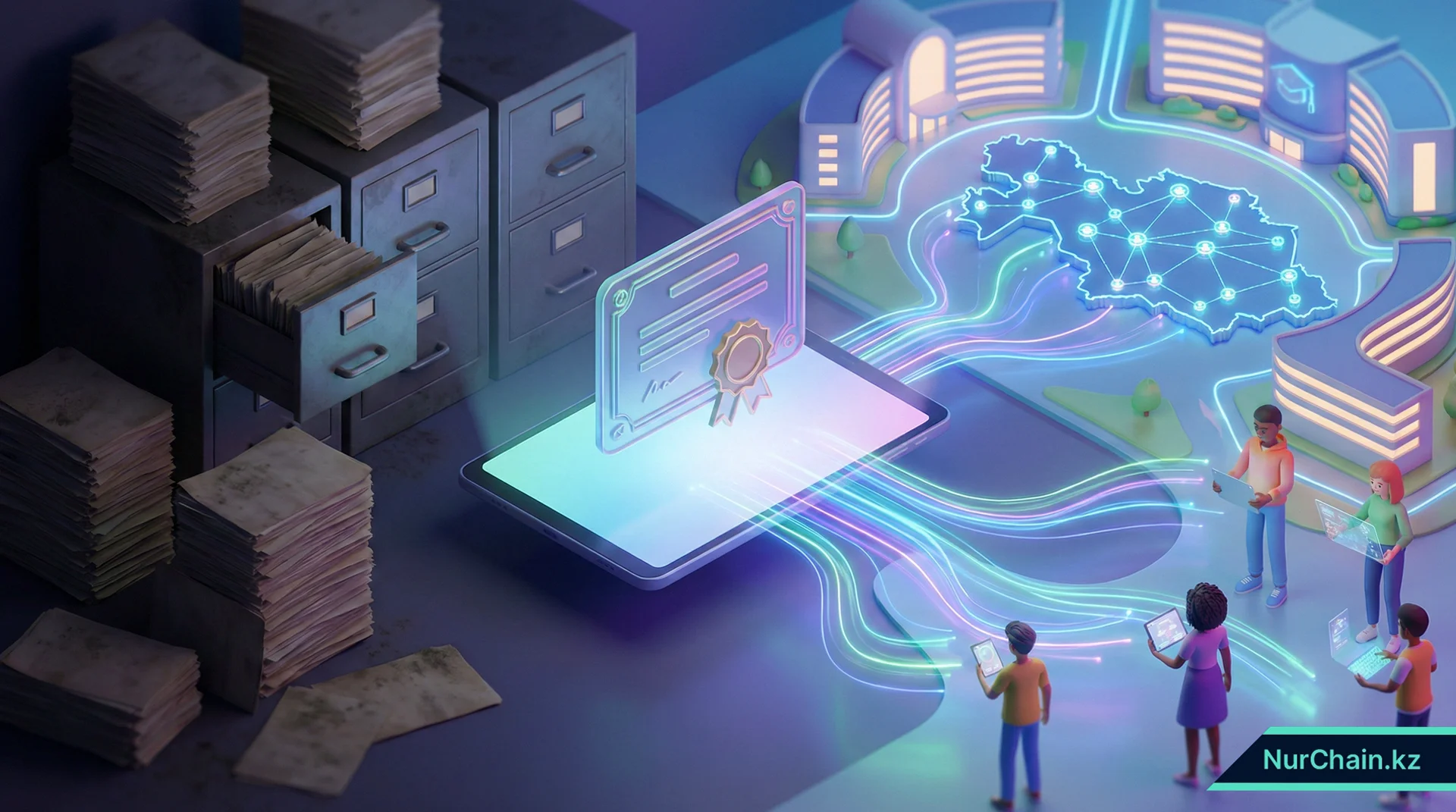
The "hidden mountain" of administrative costs behind a single graduation ceremony is enough to keep any dean up at night. Between the high price of security paper, holographic seals, and the endless hours your staff spends manually verifying old records, traditional credentialing has become a massive financial drain. You’ve seen those archives-rows of filing cabinets that represent a slow, expensive way of doing business in a fast-paced digital world.
The good news? Shifting to a blockchain-based system isn't just about following a trend; it's a strategic move that can slash your administrative overhead by up to 90%. Imagine reclaiming that budget and those human hours for actual student support instead of paperwork.
This efficiency is driven by a few core shifts in how your university handles data:
- Eliminating the "Paper Tax": You can completely do away with $15-per-page security paper and expensive international couriers by moving to secure digital issuance.
- The Speed Leap: Instead of the "multi-week manual crawl" usually required to verify a degree, blockchain allows for instant, automated cryptographic checks that take seconds.
- The "Single Source of Truth": By replacing fragmented legacy databases with a unified, immutable record, you eliminate the costly human errors that lead to legal headaches and re-issuing documents.
The bottom line is that these savings aren't just theoretical. By giving students control through digital wallets, your institution can significantly lower its liability and data management risks while staying fully compliant with modern privacy standards .
➡️ To see the detailed financial breakdown and learn exactly how to modernize your workflow, check out our full analysis on reducing university administrative costs with blockchain diplomas

Reclaiming Trust: How NFTs End the Era of Fake Degrees
It’s incredibly frustrating to think that while your students put in years of grueling study, a $22 billion global industry thrives on selling fake credentials. This isn't just a minor annoyance; it’s a direct threat to your institution's prestige. You've seen how vulnerable paper certificates are, but this is exactly where the shift to blockchain becomes a complete game-changer.
What’s truly interesting is how this technology moves beyond simply "digitizing" a document. It creates immutable education records . Think of it like carving a degree into digital stone-once it’s minted, no one, not even a corrupt official or a skilled hacker, can change, forge, or delete it. This isn't just a theory; the system relies on specific "cryptographic anchors" that make authenticity a built-in feature.
The program is built on several foundational security principles that finally make forgery a thing of the past:
- The "Digital Fingerprint" Concept: Each NFT is unique and linked to a verified university signature, making it impossible to swap or replicate.
- SoulBound Tokens (SBTs): These are cutting-edge, non-transferable NFTs that stay with the graduate forever, ensuring credentials can never be "sold" or traded on the black market.
- Real-Time Cryptographic Checks: This turns weeks of bureaucratic waiting into a three-second verification process via a simple QR code scan.
The bottom line? By adopting these tools, you aren't just adding a tech layer-you’re making the counterfeit market for your university's degrees completely worthless. To see the full breakdown of how these security layers work and how they protect the reputation of Central Asian institutions, read our detailed analysis on how NFT technology is effectively shutting down the global counterfeit diploma market.

How NFT Diplomas Align with "Digital Kazakhstan" Program KPIs
National strategies often sound like a collection of abstract goals that don't really touch our daily lives. In Kazakhstan, however, the shift to NFT diplomas is a high-stakes move already changing the game. It functions as a core part of the Digital Qazaqstan Strategy 2026 , hitting specific, aggressive targets that put the country on the global tech map.
What makes this shift truly interesting? These digital credentials act as a "fraud-killer" for the entire educational system. By turning degrees into unchangeable blockchain assets, the state tackles academic integrity head-on. The bottom line is that these reforms have already helped pull more than 28 billion tenge out of the shadow economy. That’s a massive win for transparency that directly supports the nation’s ambitious $1 billion IT services export goal .
It isn't just about the big numbers, though. This transition serves as a cornerstone of the "AI-Sana" program , which prepares a "creative society" where your achievements are as mobile as you are. Whether through eGov Mobile academic records integration or the new Social Wallet project , the goal remains the same: ensuring your hard work is recognized instantly, whether you're in Almaty or New York.
Are you curious about the specific metrics or how these high-tech tools pushed Kazakhstan to 10th place globally in the Online Services Index?
➡️ To get the full breakdown of the strategic "why" and the exact targets we are meeting, see how NFT diplomas drive our national digital KPIs

How NFT Diplomas Transform Graduation into a Lifelong Connection
Graduation has felt like a final "goodbye" for decades. You walk across the stage, shake a few hands, and once you frame that paper diploma, your connection to the university usually starts to fade. It’s a missed opportunity, isn't it? We spend years building these relationships, only to let them go cold the moment you turn the tassel.
Here’s the thing: we can flip that script entirely by moving toward Self-Sovereign Identity (SSI) . If that sounds like tech-jargon, think of it this way: instead of the university "owning" your records in a dusty database, you become the sole owner of your achievements. This creates a "live link"-a permanent, real-time connection-between the institution and the graduate that stays active throughout your entire career.
This shift produces immediate, tangible wins for everyone involved. For the graduate, it’s a massive professional boost; for example, LinkedIn profiles featuring verified digital credentials can see up to six times more views than those without them. On the flip side, the university benefits from a staggering 99% reduction in verification wait times , turning a weeks-long administrative headache into a one-click process.
The bottom line? We’re moving away from one-off transactions and toward a future where your degree actually works for you every single day. But how do you go from a static PDF to a dynamic system that tracks career mobility and boosts engagement by over 30%?
➡️ To explore the full framework for building these lasting bonds and see how schools are automating 90% of their registrar's workload, see how digital credentials transform your alumni network into a lifelong partnership

The Value of Instant Global Verification for Kazakhstani Graduates
The excitement of landing a job offer abroad or getting into a top-tier university can vanish the moment you see the "apostille" requirements. We’ve all been there-stuck in a bureaucratic waiting game that can drag on for 45 days while someone manually digs through an archive. It feels like your future is on pause because of a paper-based system that hasn't changed in decades.
This is where the shift to instant global verification changes the entire trajectory of your career. Instead of a physical document that needs a government seal, your achievements become a "portable asset" you carry in your pocket. The framework behind this transition focuses on three core pillars that solve the most common headaches for graduates:
- The "Apostille Killer": By using blockchain, we’ve effectively shrunk the verification timeline from weeks of stress to literally three seconds.
- The Trust Bridge: This tech provides "cryptographic certainty." In simple terms, it gives elite institutions like Oxford or Harvard mathematical proof that your degree is 100% authentic , bypassing the $12.5 billion global fraud problem.
- Self-Sovereign Identity (SSI): This sounds technical, but it’s actually quite empowering. It means you own your data, not a university or a government office. You decide who sees your credentials and when.
The bottom line? The world is moving toward a "digital-first" economy, and paper diplomas are becoming a liability. But how does this system actually bypass manual archival checks, and what makes these digital credentials compliant with international standards like GDPR ?
➡️ To see exactly how to turn your degree into a friction-free global asset, learn how instant verification eliminates apostille delays and secures your global career

Gaining Competitive Advantage: NFT Diplomas in the Kazakhstani Education Market
Handing a graduate a paper diploma feels a bit like using a paper map when you really need a GPS-especially in a country where almost every public service is just a few taps away on a smartphone. If you’re leading a university, you know the pressure is on to stay relevant. It’s not just about keeping up; it’s about standing out in a market where students and employers expect digital-first innovation as the standard, not an exception.
The good news? Shifting to NFT diplomas isn't just a tech upgrade-it's a massive strategic win for your institution's bottom line. This move can slash your administrative costs by a staggering 90% . Imagine cutting verification times from weeks of manual archive digging to just a few milliseconds. Beyond internal efficiency, this shift helps the national economy by wiping out "shadow transactions" that have historically cost billions of tenge in lost trust and red tape.
But how do you actually turn this technology into a long-term competitive edge? It starts with claiming a first-mover advantage . By becoming a visionary "Smart University" today, you’re not just protecting your reputation against sophisticated forgery; you’re giving your graduates a "fast pass" to global careers. You are providing them with a digital asset that international employers-who increasingly demand cryptographically verifiable skills-can trust instantly.
There is a specific roadmap for making this happen, from leveraging localized high-security ecosystems like KazSmartChain to meeting the high expectations of the 76% of Kazakhstani youth who already drive the digital economy. Understanding these dynamics is the key to ensuring your institution doesn't just survive the digital shift but leads it.
➡️ To see the full blueprint on outperforming the competition and securing your institutional prestige, learn how to secure your first-mover advantage in the Kazakhstani market

The Environmental Impact: Why Digital is the Green Standard
We love the weight of a heavy, embossed diploma. It feels official and represents years of grit. But if you pull back the curtain, that traditional paper prestige carries an environmental price tag that’s getting harder to justify. It’s not just about "saving a few trees"-it’s about a massive, hidden drain on our natural resources that happens long before the graduate even walks across the stage.
The shift to digital credentials is a strategic move toward sustainability, and it’s built on some pretty eye-opening data. The "paper vs. digital" debate isn't just a tech trend; it's a direct response to a resource crisis. To give you an idea of the scale, the process of creating just one A4 sheet of diploma paper devours about 10 liters of water . When you multiply that by thousands of students, the savings from going digital aren't just significant-they’re astronomical.
Then there’s the "hidden" carbon footprint of global logistics. Here’s the thing: nearly 41% of a physical document’s total carbon impact actually comes from the fuel used by planes, trucks, and couriers to deliver it. By switching to energy-efficient Proof-of-Stake blockchain technology, you bypass that entire carbon-heavy supply chain. In fact, sending a digital diploma this way drops the carbon impact to a tiny 2.5g of CO2. It’s the difference between driving a delivery truck across the country and flicking on a light bulb for a few seconds.
Beyond the "green" feel-good factor, this transition gives your university the hard "activity data" needed for ESG (Environmental, Social, and Governance) reporting . Instead of just claiming to be eco-friendly, you can provide verifiable proof of how your institution is meeting UN Sustainable Development Goals like Responsible Consumption and Climate Action. It’s a powerful way to show students and donors that your values aren't just on paper-they’re built into your infrastructure.
To see the data behind these savings and learn how your institution can lead the way in green education, explore the full environmental and ESG breakdown

Turning Graduation Data into a Strategic Success Map
Graduation day is a celebration, but for administrators, it often marks the start of a "data black hole." Once those caps are tossed, tracking where your alumni actually go becomes a game of "wait and see." You’re stuck relying on old-school surveys that rarely tell the whole story, leaving you feeling like you're flying blind when trying to measure your university's real-world impact.
What if your diplomas could talk back? By leveraging the analytics built into NFT credentials, you can finally replace guesswork with a real-time mobility heat map . This isn't just about knowing a student landed a job; it’s about seeing exactly which global industries and geographic hubs are verifying your university’s degrees at any given moment.
The reason why this matters? These insights create a powerful, direct feedback loop for your entire institution. Here is the bottom line of what that looks like in practice:
- Tracking Graduate Mobility: Instead of wondering where your graduates end up, you can see a live map of verification requests. If a cluster of pings comes from a tech hub in Berlin or a financial center in Seoul, you know exactly where your brand is gaining traction.
- Curriculum Alignment: You can monitor which specific degrees or micro-credentials employers check most often. If 90% of verifications hit your data science modules, you have the proof you need to double down on high-demand programs .
This data-driven approach does more than just satisfy curiosity. It’s a strategic tool that helps you slash administrative verification costs by up to 90% and provides the hard evidence you need to climb international university rankings. It turns a one-time document into a lifelong asset for both the student and the university.
To see the full breakdown of how to harness these insights for your institution, read our deep dive on leveraging NFT diploma analytics for institutional growth

Summary: Transforming Kazakhstani Higher Education into a Global Digital Powerhouse
By adopting NFT diplomas, universities in Kazakhstan are doing far more than updating their record-keeping. They are fundamentally redefining their value in the global market. What this means is that this transition effectively solves the critical "trust gap." This gap is caused by the global forgery industry. We can fix this through immutable records. These are records where data cannot be altered or deleted. Think of them as being "carved in digital stone." This directly boosts employer and academic reputation. As we know, these are the two heavyweights in international university rankings.
By moving toward a model of Self-Sovereign Identity (SSI), institutions empower their graduates. SSI is a digital identity framework that gives individuals control over their own data. This provides them with what we like to call an "apostille killer." To be fair, no one likes waiting months for paperwork. This system turns those months of bureaucratic waiting into something much faster. It creates just a few seconds of cryptographic certainty for employers worldwide.
The bottom line is that these pillars create a massive ripple effect. Administrative overhead is slashed by up to 90%. Environmental footprints are also minimized to meet high ESG standards. These are the Environmental, Social, and Governance criteria we all aim for. Additionally, the university gains a "strategic success map" through real-time data analytics. This data-driven approach allows you to track graduate mobility. You can also align curricula with actual industry demand. This turns a one-time graduation ceremony into a lifelong partnership with your alumni. Ultimately, this shift is the practical realization of the "Digital Kazakhstan 2026" strategy. It ensures that a degree from a Kazakhstani university is a respected asset. It becomes a secure and portable credential recognized instantly from Almaty to New York.
