Defining User Access Roles: Who Can Mint University NFTs?
 Author:
 Reading time:
11 min
Reading time:
11 min
 Difficulty:
Easy
Difficulty:
Easy
- Establishing the Registrar as the Ultimate Authority for Minting
- Implementing Role-Based Access Control (RBAC) in Smart Contracts
- Why Technical Staff Must Be Excluded from Issuance Rights
- Managing the Lifecycle: The Revoker and Pauser Roles
- Summary: Securing Academic Integrity through Strategic Access Control
Think about this for a second. You’ve poured four years of life into your studies. You survived the sleepless nights and invested heavily to earn that degree. Now, imagine discovering a $21 billion global fraud industry. This criminal market for counterfeit credentials is massive. It churns out high-quality fakes that look exactly like your hard-earned diploma. It’s frustrating, isn't it? Since AI makes forging traditional PDF diplomas effortless, the problem is only getting worse. How do we actually protect the real-world value of your achievements?
You’ve come to the right place for answers. Defining university NFT minting roles offers a smart, strategic shield against this crisis. It shifts academic credentials away from vulnerable files that anyone can copy. Instead, it secures them as blockchain-backed assets . Think of these as digital items locked within a decentralized ledger. When you establish the Registrar as the official Authorized Issuer , your university regains total control. Only the legal custodians of student records hold the power to "mint" these digital diplomas. Minting simply means creating a permanent, unique token on the blockchain. We are going to break down exactly why this matters. You'll see why technical staff must never handle the actual issuance process. We will also explore Role-Based Access Control (RBAC). View it as a digital "keycard" system designed for high-level security. Finally, we'll look at why the "Two-Person Rule" serves as the ultimate reputational safeguard. This protocol requires two authorized people to complete any sensitive task, ensuring no single point of failure.
🏗️ Establishing rigorous access roles provides a foundational security layer for the Technical Guide for NFT Diplomas.
Establishing the Registrar as the Ultimate Authority for Minting
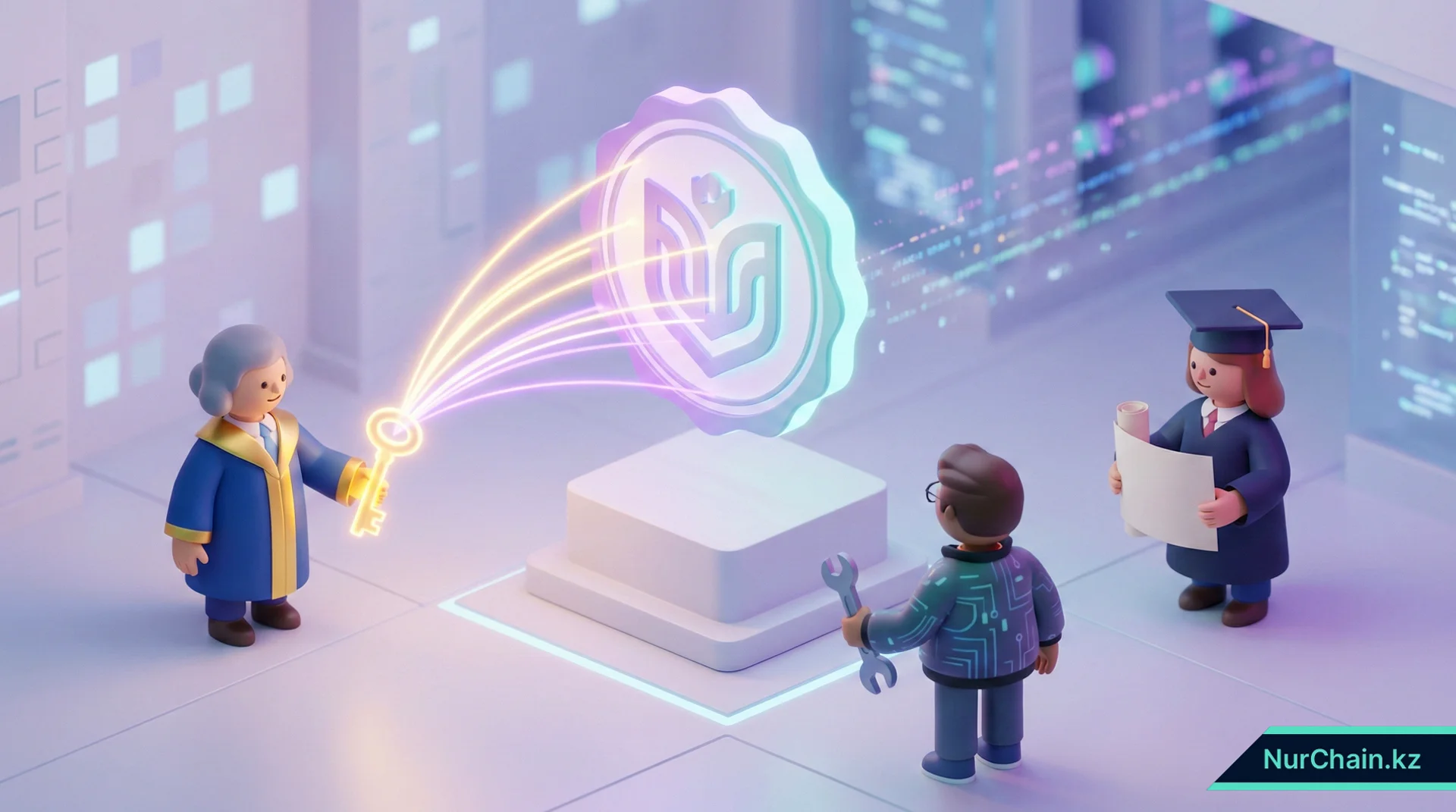
Who exactly should hold the "golden key" to your personal academic legacy? This question sits at the heart of university NFT minting roles for any modern institution. In the fast-moving world of digital credentials, this isn't just a technicality-it’s a fundamental matter of institutional trust. Who, then, should have the ultimate authority to mint university NFTs? To protect a degree's real-world value, the Registrar's office must serve as the primary "Authorized Issuer" . Recognizing the Registrar as the official issuer ensures the process remains under the control of those who manage legal records. Think of them as the legally recognized custodians of student achievements, a role that is now more critical than ever.
We're currently facing a global academic fraud ecosystem worth an estimated $21 billion USD. By restricting minting capabilities-a process detailed in the technical process of minting nft diplomas-you create a vital defense against forgeries and prioritize credential fraud mitigation . This strategy aligns with industry benchmarks like the Gartner Hype Cycle, which identifies decentralized identity (DID) management as a mature solution for the fraud market by 2026. Statistics show that forgeries have increased by a staggering 244% year-over-year because AI tools make traditional PDFs incredibly easy to manipulate.
We recommend Multi-signature (Multi-sig) wallets to make the system even more secure, ensuring administrators know how to securely manage private blockchain keys. This essentially establishes a "Two-Person Rule" where both a Registrar official and a department head must cryptographically sign off on a transaction. It’s a proven strategy; in fact, over 60% of major digital asset custodians use this exact architecture to eliminate single points of failure. This hierarchy ensures that the minting process carries the same weight as a physical signature, directly addressing the fact that 30% of employers worry about whether credentials are valid.
Why It Matters: By keeping the Registrar at the center of the minting process, the university ensures that every NFT issued carries the full weight of the institution's authority, effectively neutralizing the fake degree industry and the risks of unauthorized NFT diploma issuance .

Implementing Role-Based Access Control (RBAC) in Smart Contracts
How do we actually enforce these rules in the digital world? We embed
Role-Based Access Control (RBAC)
-a method for regulating access based on specific user roles-directly into the smart contracts themselves. This direct approach to
smart contract permission management
ensures only the people with specific clearance can take action. It allows us to define clear permissions, such as
ADMIN_ROLE
,
MINTER_ROLE
, and
REVOKER_ROLE
. You might wonder: how does RBAC actually protect digital diplomas? By using these specific administrative roles, the system builds defense layers that stop anyone from overstepping their authority. This isn't just a niche tech trend; it’s part of an EdTech market that experts expect to grow steadily through 2035.
This framework follows
NIST Special Publication 800-162
, which sets the gold standard for secure access models in digital environments. These standards serve as the bedrock for
digital credentialing platform security
. In this setup, the Registrar’s office exclusively holds the
MINTER_ROLE
via their blockchain addresses. This stops "credential inflation"-the devaluation of degrees through over-issuance-and protects the integrity of a market that experts believe will hit $9.24 billion by 2033.
Meanwhile, your IT staff and system administrators receive a
SUPPORT_ROLE
or
VIEWER_ROLE
. This lets them manage your IT infrastructure requirements without giving them the power to issue a single diploma. By using
OpenZeppelin’s AccessControl
-the industry standard for secure smart contract management-universities create a transparent, auditable trail. This level of oversight is vital when you realize identity fraud losses could reach $10.5 trillion every year by 2025.
Quick Insight: Think of RBAC as a digital keycard system. Just because someone has the key to the building (the IT staff), it doesn't mean they have the key to the vault (the Registrar's minting rights).

Why Technical Staff Must Be Excluded from Issuance Rights
Giving tech experts full control over blockchain issuance might seem counterintuitive at first. After all, shouldn't the "tech pros" be the ones running the show? This leads many to ask: Why should IT staff be excluded from minting rights? In reality, separating duties is an absolute cornerstone of digital security. Practicing separation of duties in blockchain education ensures no single person holds too much power over the issuance process. Even when IT experts manage eGAB Chain or Ethereum nodes using Web3 API integration for university developers, they must never have the authority to validate academic truth. Adopting this strategy can slash the risk of internal theft and fraud by up to 80%.
Think of it this way: if IT staff have minting rights, one compromised admin password lets an attacker bypass the very protocols that protect your university’s brand. It's all about locking down academic credential access control through strict blockchain diploma security protocols. By separating technical maintenance from cryptographic authorization, universities align themselves with the massive trend in the fraud detection market. This sector hit a massive $33.13 billion valuation in 2024 with an 18.7% CAGR. This division of labor isn't just for show; it's essential for passing your institutional audits. It draws a clear line between the people who build the digital roads and those authorized to drive the "armored trucks" of verifiable credentials.
Takeaway: Keeping technical maintenance and academic authorization separate is the best way to safeguard your university's most valuable asset: its reputation for integrity and excellence.

Managing the Lifecycle: The Revoker and Pauser Roles
What happens if a degree is awarded in error, or if a student's record needs to be updated? Understanding how to handle retractions and corrections is exactly where lifecycle management roles come in. These
revoker and pauser roles in NFTs
give you the oversight needed for long-term maintenance and fixing errors. This brings up an important practical question:
How to revoke a digital academic credential on the blockchain?
We use a specialized
REVOKER_ROLE
that lets only the Registrar "burn" (permanently remove) or invalidate an NFT. It's a must-have feature as the digital badge market grows toward
$969.7 million by 2032
.
You can instantly verify revocation status across borders using the
W3C Verifiable Credentials Data Model
(the global standard for secure digital credentials). This ensures top-tier data integrity and interoperability, so different systems talk to each other perfectly. Your credentials will meet global standards for
Verifiable Credentials (VCs)
and follow the official W3C Data Model. We also include a
PAUSER_ROLE
. Think of this as an emergency brake for the system. High-level security officers can use this to freeze all minting if they detect a vulnerability. With cyberattacks up
125%
worldwide, this failsafe-along with disaster recovery and backup strategies-is non-negotiable.
To add another layer of protection, we recommend using multi-signature wallets for academic records . But how do multi-sig wallets enhance university security? They work by requiring collective consent before anyone makes a critical change. You might wonder: What is the "Two-Person Rule" in digital credentialing? Basically, it ensures no single person can act alone. We record every change in these roles on-chain, creating a permanent on-chain audit trail . This setup supports the "lifelong learner" model in a market set to hit $133 billion by 2030 . You can even automate this; for example, if staff leave, the HR system instantly cuts their access to protect the SESGD integrity of your entire network.
Try This: Periodically review who holds the "Pauser" and "Revoker" roles. Ensuring these high-power permissions are strictly limited is the key to maintaining a resilient and trustworthy digital archive.

Summary: Securing Academic Integrity through Strategic Access Control
Protecting the value of a university degree in the digital age is vital. You must rethink how you manage authority to stay ahead. A secure digital credential system depends entirely on having clearly defined roles. Specifically, you must ensure the Registrar acts as the sole Authorized Issuer .
This strategy creates a direct defense against a massive $21 billion academic fraud market . It actively fights the deceptive practice of falsifying educational qualifications. Our approach ensures the power to create university NFTs stays exactly where it belongs. It remains with the people legally responsible for student records and the vital task of standardizing student data. You can also apply a "Two-Person Rule" through Multi-signature wallets . These digital wallets require two or more private keys to authorize any transaction. By doing this, your school effectively eliminates "single points of failure." These are vulnerabilities that can stop your entire operation if they fail. In plain English, it means no one person acting alone can cause harm. They cannot accidentally or intentionally hurt the university’s reputation. Most importantly, they cannot devalue a student's hard-earned degree.
All of these moving parts work together through Role-Based Access Control (RBAC) . This isn't just a technical term; it's a way to build security standards directly into your system. This framework follows global standards, like NIST and the W3C, to ensure a strict separation of duties . This practice splits tasks among multiple people to prevent fraud before it happens. Think of it this way: your IT team keeps the engine running, but the Registrar’s office is the only one with the keys to drive. We also include Revoker and Pauser roles. These specific authorities allow you to invalidate a credential or temporarily halt system activities. Because of this, universities have a much-needed safety net to fix errors. You can also freeze operations immediately if a cyber threat pops up. By layering these protections together, including rigorous QA testing before mass issuance, you are doing more than just handing out digital files. You are building a transparent, trusted system. This protects the lifelong value of an education for students and employers everywhere.
🚀 Ready for execution? Now that you have defined who holds the power to issue credentials, it is time to look at the workflow itself. Dive into The Technical Process of Minting to see how these authorized roles create secure assets on the blockchain.
