Integrating NFT Diplomas with Metaverse Virtual Campuses
 Author:
 Reading time:
11 min
Reading time:
11 min
 Difficulty:
Easy
Difficulty:
Easy
Have you ever imagined walking through a sprawling 3D digital campus? This is a three-dimensional simulated environment where your hard-earned degree actually opens virtual doors. It sounds like something straight out of a sci-fi movie, doesn't it? But for many, the days of paper diplomas-those certificates just gathering dust in a frame-are ending.
The real challenge you face today isn't just earning a qualification; it's proving it’s the real deal. In a digital-first world, you need to authenticate validity quickly to avoid the constant headache of manual checks. You also want to bypass "digital walls," those frustrating barriers to information access.
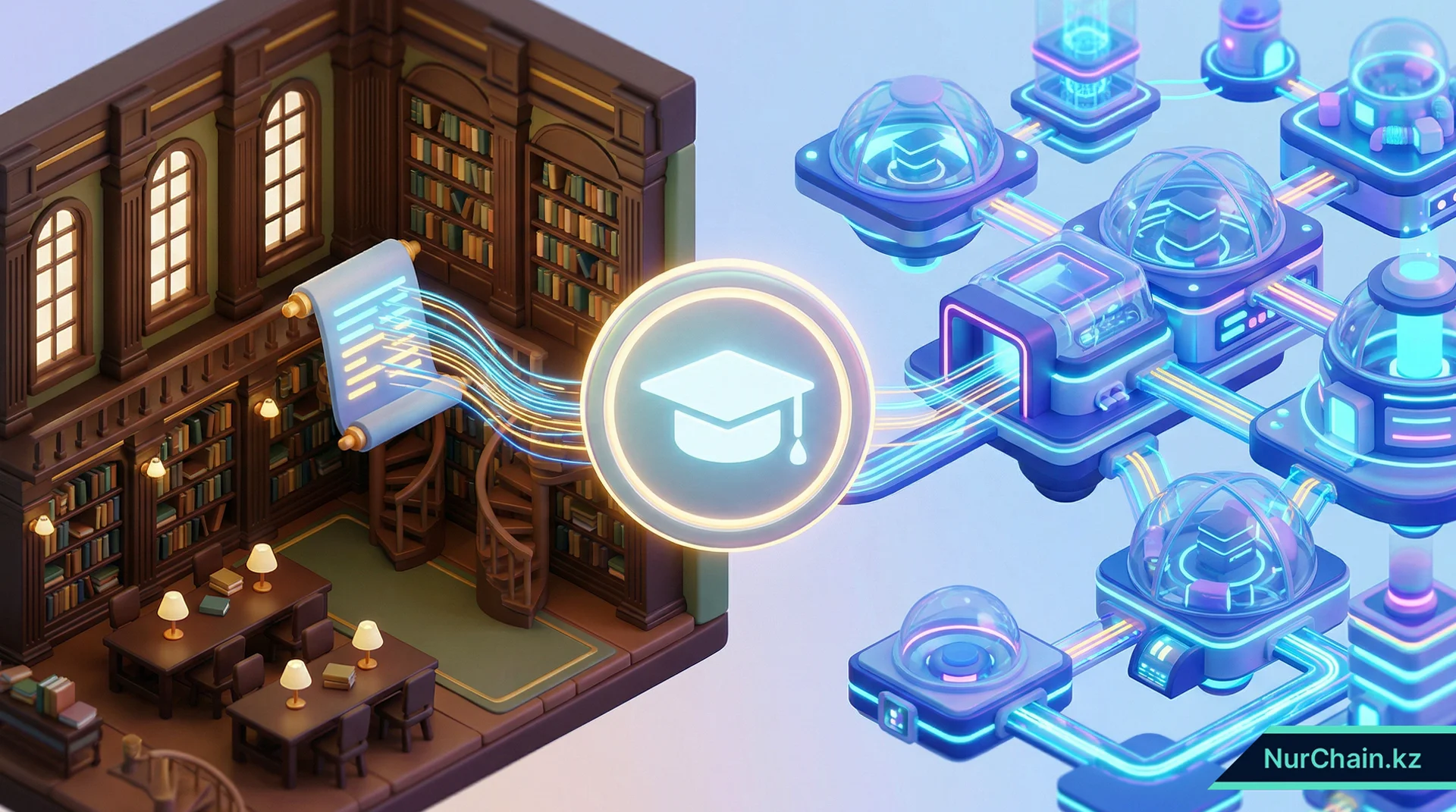
This is exactly where integrating NFT diplomas with Metaverse virtual campuses changes the game. We are transforming a static certificate into a functional, verifiable access key -a digital tool that grants entry based on proven ownership. Because of this, we're seeing a major shift toward a more secure and immersive way to learn and work. In this article, we’re going to explore how these NFT diplomas serve as gated access tokens . You'll also see how to showcase your achievements in 3D digital offices and why this technology is a powerful solution for eliminating credential fraud while promoting global talent mobility.
🏗️ Integrating immersive virtual environments with blockchain-backed credentials is a cornerstone of the strategic evolution detailed in The Future of EdTech in Kazakhstan Beyond Digital Diplomas.
How Do NFT Diplomas Serve as Verifiable Access Keys in the Metaverse?
Have you ever imagined walking through a sprawling 3D digital campus where your hard-earned achievements actually open doors for you? In the decentralized worlds of the future, an NFT diploma is much more than just a digital image sitting in a folder. But how do these diplomas actually work as access keys? Using NFT diplomas in the Metaverse allows them to function perfectly as virtual campus access keys. Think of it as a high-tech "smart key" or a gated access token. By simply keeping these tokens in your digital wallet, you automatically gain entry to exclusive zones like alumni lounges, graduate-only networking events, or advanced research labs. This isn't just a niche concept for tech enthusiasts; it's the foundation for a Metaverse in Education market projected to reach a staggering $11.19 billion by 2025. When people ask about the benefits of NFTs for virtual campuses, the answer lies in this seamless blend of identity and utility. Recent market analysis from Grand View Research shows a massive surge in demand for this decentralized academic infrastructure, leading many to explore if DAO universities are the future of education.
The real magic happens through Smart Contract automation . This verification ensures the whole process is entirely trustless and objective. Instead of waiting for a human to manually check a database, virtual campus gates instantly verify your credentials in the background. You might wonder: how do smart contracts automate student access to virtual labs? The code simply checks for the specific token in your wallet and triggers the door the moment you approach. This delivers a remarkable 90% improvement in operational efficiency compared to old-school manual methods that usually drag on for 5–7 business days.
This setup allows for incredibly precise tiered permissions within a digital office or campus. By managing these permissions and gated content, institutions ensure only authorized individuals interact with sensitive materials. For instance, high-level academic discussions or specialized laboratories stay locked unless you can cryptographically prove you have the right background. We’re already seeing the scale of this shift, with over 320 million digital credentials issued by 2025. Because these tokens use standard protocols like ERC-721 or ERC-1155, they offer true interoperability. In plain English, a diploma earned in one EdTech ecosystem is instantly recognized across different Metaverse platforms-a critical feature for a $10 trillion global education market expected by 2030.
Why It Matters: Using NFTs as access keys transforms your degree into a functional tool. It eliminates the friction of proving your identity repeatedly, letting you move seamlessly between digital learning and professional environments with your "key" always in hand.

How Can Graduates Display Their Achievements in 3D Digital Offices?
Why settle for a dusty framed paper on a wall when you can turn your workspace into a high-tech showcase instead? If you’re a young professional asking how to display academic achievements in a virtual office , you already know the goal: standing out in a crowded digital world. Using verifiable credentials for digital offices lets you build a workspace that speaks volumes about your expertise. You can render an NFT diploma as a 3D digital diploma display-think of it as a high-fidelity 3D asset, like a sleek, rotating holographic plaque. Placing these 3D assets and holographic plaques in your environment offers visual proof of your skills that's way more engaging than a flat image. The demand is real: 72% of employers now say they prefer micro-credentials and nanodegrees that offer instant, tamper-proof validation. Wondering about the difference between traditional diplomas and NFT certificates? It's simple: the NFT version is living, interactive proof of your entire journey. This shift is backed by global digital credential standards from the W3C, providing the rock-solid framework for secure, 3D academic representations.
These digital credentials are far smarter than a standard PDF. They carry embedded metadata-extra info like issuer details and completion dates-that lets a recruiter or colleague click the object to see your full story. They can instantly view your GPA and verifiable transcript without you ever hitting "send" on an email. Having metadata and verifiable transcripts available at a click makes the vetting process incredibly easy. This transparency helps universities solve a massive problem, driving an 85% decrease in diploma fraud attempts at schools that have embraced blockchain.
As a modern professional, you can use this tech to build a personalized Personal Achievement Gallery. In this gallery, your soulbound tokens for academic achievements serve as permanent, unalterable proof of your expertise. This fits perfectly with the massive shift toward skills-based hiring. Actually, 94% of employers report that candidates hired for specific, verified skills outperform those who only hold traditional degrees. On social VR platforms, you can tuck these credentials into a digital skills wallet and link them to your 3D Avatar, showing off a "verified graduate" badge via your connected wallet. It’s a huge boost to your professional visibility at a time when job skill requirements are jumping by 10% every year.
Takeaway: Your digital office is your new resume. By displaying 3D-rendered NFT credentials, you aren't just decorating a virtual space-you are providing immediate, clickable, and unfakable evidence of your value to every client or employer who "walks" by.

What Are the Strategic Advantages of Connecting NFTs to Virtual Learning Spaces?
Connecting NFTs to Virtual Learning Spaces isn't just about cool visuals; it’s about a fundamental shift in how we value and move education across borders. When you issue blockchain-based academic certificates, you give students assets that are globally portable and instantly verifiable. You can even host Virtual Graduation Ceremonies where the "minting" (the process of recording a unique asset on a blockchain for the first time) of the NFT diploma happens live. This automation is a massive win for your budget, slashing the average issuance cost from $15 per certificate down to a mere $1–2. This shift sits at the heart of the Web3 education movement , putting data ownership back where it belongs: with the student.
By integrating these tokens with the Metaverse, universities finally close the gap on a global crisis. You might ask, " Can NFT diplomas reduce credential fraud? " The answer is a resounding yes-they make unauthorized replication nearly impossible. This technology helps wipe out the $2 billion in annual global losses caused by fraud and those agonizing delays of traditional verification. For a global recruiter, background check automation through blockchain means the hiring process moves significantly faster. This creates a career-long persistent academic identity (a lifelong, digital record of learning history) where every step of a student’s progress is cryptographically tracked. Using cryptographic verification ensures that every achievement listed is legitimate and untampered. This is an essential tool, especially since the World Economic Forum (WEF) highlights the need for reskilling -a challenge you can address through the synergy of AI and blockchain. It predicts that 1 billion people will need help navigating technological disruption.
The most exciting impact, though, is on global talent mobility . But how exactly does the Metaverse change global recruitment? It essentially dissolves the borders that used to limit where you could work. Imagine a graduate in Kazakhstan, perhaps benefiting from the nation's 10-year roadmap for digital education, applying for a role in Silicon Valley. Usually, that means a mountain of paperwork and expensive international notarization. By using an NFT diploma , that graduate can "walk into" a virtual job interview and present a record that is 100% tamper-proof and instantly recognized. It levels the playing field, ensuring that talent gets recognized no matter where the student is physically located.
Did You Know? The shift to NFT-based credentials in the Metaverse is a major step toward "borderless" employment. It removes the physical and financial barriers of verification, making it just as easy to hire a verified expert from across the globe as it is to hire someone from across the street.

Bridging the Gap Between Achievement and Utility in the Metaverse
What does bringing blockchain and virtual environments together actually mean for your career? Think of it this way: this integration transforms the traditional diploma into a dynamic, "smart" tool. It is no longer just a passive piece of paper. You can now use NFT diplomas as virtual campus access keys -cryptographic assets that unlock specific digital locations. Because of this, your transition from student to professional becomes incredibly smooth.
You achieve this through smart contract diploma verification , which uses self-executing code to validate credentials automatically. Universities and companies then automate access to exclusive zones, like alumni areas or research labs. In practice, this delivers a 90% improvement in operational efficiency . You won't have to wait a week for manual record checks; instead, the system handles everything in the background instantly.
It isn't just about making things easier, though. It is about building a decentralized academic infrastructure where no single central authority controls your records. We use tiered permissions to keep sensitive data and discussions secure. This ensures only those with the right cryptographic credentials can get in.
The impact goes far beyond the campus, reaching straight into the "Meta-Office" where your achievements take on a whole new life. You don't have to settle for a flat PDF anymore. Now, you can use 3D digital diploma displays that look like rotating holographic plaques. They act as clickable, interactive proof of your skills. These assets are often issued as soulbound tokens-non-transferable NFTs permanently linked to your private blockchain address.
These tokens come with embedded metadata and verifiable transcripts that include your detailed academic history. This allows recruiters to verify your GPA and background with a single click. Here’s the best part: this level of transparency acts as a massive weapon against dishonesty. In fact, it should lead to an 85% decrease in diploma fraud attempts .
You can link these credentials to a 3D Avatar , your digital representation in a virtual space. You do this through a digital wallet-the software that manages your cryptographic keys. As a result, you maintain a career-long persistent academic identity recognized all over the world.
Ultimately, the biggest strategic advantage here is global talent mobility . This allows skilled workers to move and work easily across borders without expensive, slow processes. You no longer need to mail and notarize paper documents across the globe. Now, a graduate instantly proves their qualifications to an employer on the other side of the world.
This Web3 education model slashes costs for schools and levels the playing field for the 1 billion people needing new skills by 2030. By connecting NFTs to virtual learning spaces, we are moving toward a borderless world. Your hard-earned talent will be 100% tamper-proof, instantly recognized, and always ready to open your next big door.
🚀 Ready to explore the governance side? Now that you see how NFT diplomas grant access to virtual campuses, discover how the institutions themselves are being decentralized. Dive into Are DAO Universities the Future of Decentralized Education?
