Integrating NFT Diplomas with Platonus and Univer Systems
 Author:
 Reading time:
13 min
Reading time:
13 min
 Difficulty:
Easy
Difficulty:
Easy
Think about how you send money-it travels across the globe in seconds, right? So why does degree verification still feel so outdated? Honestly, it feels like a trip back to the twentieth century. We face a rising threat of document forgery-the fraudulent alteration of records-and a bureaucratic maze of transcript requests. Paper diplomas are struggling; they simply can't keep up with modern demands.
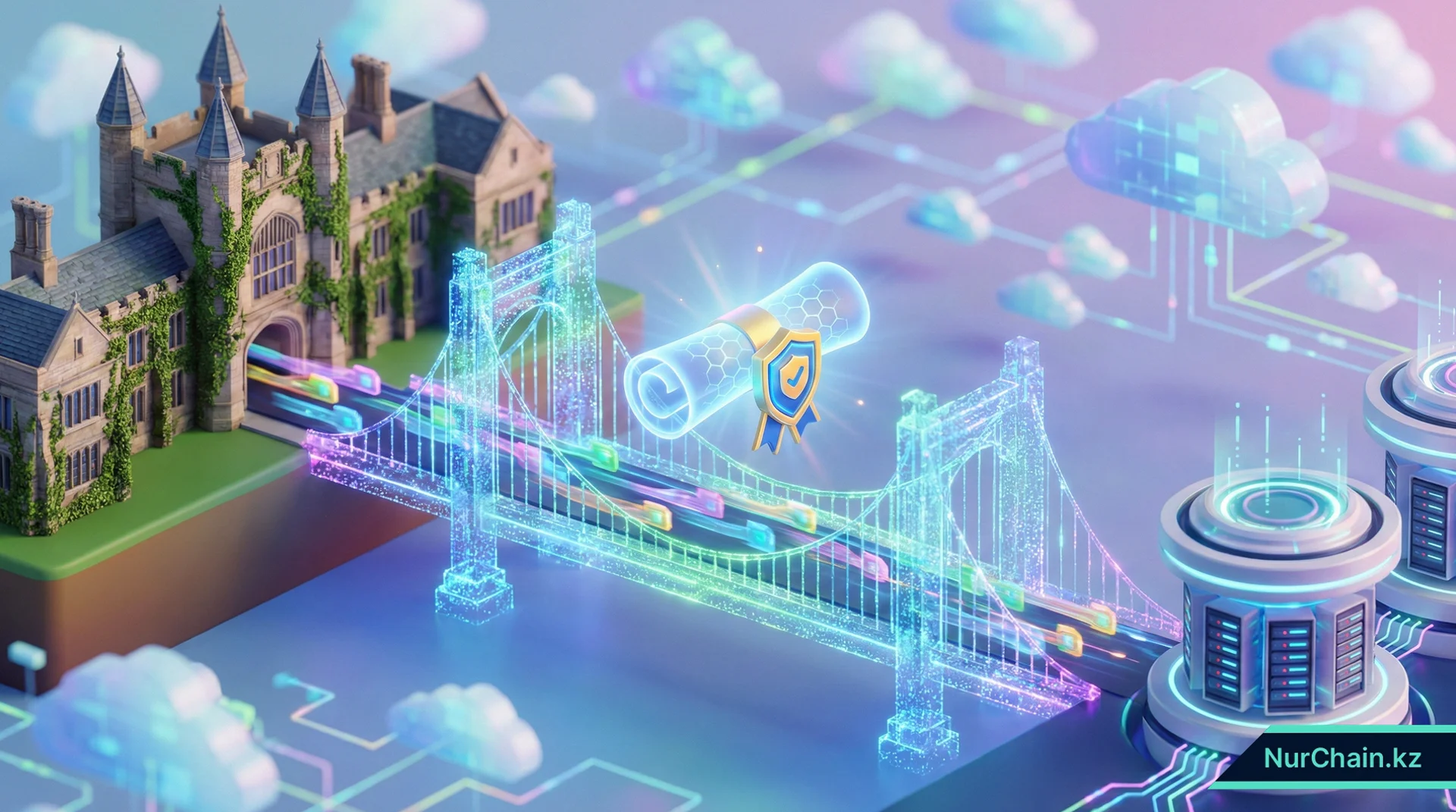
Integrating NFT diplomas with Platonus and Univer systems is a revolutionary game-changer for schools. This evolution is a cornerstone of digital diploma issuance , and Kazakhstan is proudly pioneering it right now. The system acts as a secure bridge, connecting university databases to the power of the blockchain, while offering a choice between SaaS vs custom blockchain solutions. Remember: blockchain is a distributed ledger for recording transactions that runs across many computers.
We use what's called a RESTful API . Think of this architectural style as a digital translator that uses HTTP requests to access and use data. Your institution uses it to transform sensitive graduate data into a lifelong, verifiable asset that belongs entirely to the student.
Here, we'll explore the technical "heavy lifting" involved in connecting Platonus (Kazakhstan's automated educational system) and Univer 2.0 (a comprehensive university management platform) to the blockchain. We’ll show you how these systems prevent academic fraud -any form of cheating in academic exercises-and cover the essential criteria for choosing platforms in Kazakhstan. These choices must account for pricing models while meeting the country's strict legal standards.
📘 Mastering the technical integration between ERPs and blockchain is a critical implementation phase of the broader strategy found in our Top Rated NFT Diploma Platforms in Kazakhstan review guide.
How to Connect NFT Platforms to Kazakh ERP Systems via API
How do we bridge the gap between traditional university databases and the cutting-edge world of Web3 ? It’s a challenge many in the tech space are tackling right now, and the solution starts with the API (Application Programming Interface). This setup anchors the digital diploma issuance Kazakhstan is currently pioneering. Think of a RESTful API as a digital translator that allows platforms like Platonus and Univer to talk directly to a blockchain minting engine. By implementing a RESTful API for educational records, you ensure the transfer is both standardized and secure. Through this specific setup, universities can safely push sensitive graduate data-from full names and GPAs to the specific Diploma Serial Number-straight onto the blockchain. This allows real-time student data synchronization blockchain protocols to work flawlessly. It’s a massive shift; market analysts project the global blockchain education market will hit $3.07 billion by 2030, growing at a CAGR of 43.94%. When universities adopt blockchain educational credentials, they provide students with a lifelong, verifiable asset.
Right here in Kazakhstan, successful case studies like the UniverCert platform are already proving this works. You might wonder: What is the difference between a digital copy and an NFT diploma? While a PDF is just a file, an NFT is a unique record verified by a global network. We developed this specifically for our higher education landscape, using a RestAPI layer to link university databases with a consortium Ethereum blockchain . This creates a single, immutable digital register of achievement. The timing is critical because the numbers are startling: 2024 alone saw a 244% year-over-year spike in digital document forgeries. Naturally, you’ll ask: What are the legal requirements for digital diplomas in Kazakhstan? Meeting national standards is the first step toward building trust through cryptographic verification . By automating the sync between the ERP and the blockchain, we move toward "one-click" issuance. When you approve a graduation order in the Platonus module, it triggers a smart contract automatically. With a global digital credential market valued at $1.8 billion, this level of efficiency is vital. Plus, are NFT diplomas recognized by the Ministry of Science and Higher Education? Current initiatives show a strong push toward official recognition for these secure digital formats.
The process doesn't end with sending data; it’s about creating a flawless feedback loop. High-tier platforms, often highlighted in global platform reviews, use webhooks to notify the university’s system the moment a diploma is minted. Using Webhooks for minting status ensures your database updates the second a record is finalized. The system then automatically updates the student’s profile with a permanent IPFS link and the NFT contract address. "The integration of blockchain into ERP systems represents a fundamental shift toward data sovereignty for students," notes a report by the Gartner Group on emerging educational technologies. This level of automation serves as the ultimate weapon against academic fraud, ensuring every record remains verifiable and permanent.
Did You Know? Webhooks act like a digital "ping." Instead of your system constantly asking the blockchain "Is it done yet?", the blockchain simply notifies the ERP the moment the NFT is ready, saving immense processing power and time.

Technical Compatibility with Platonus ERP
How do you actually bring this technology into the systems your registrars (university officials who manage student records and academic data) use every day? If you're wondering how to connect Platonus to an NFT platform, it usually involves setting up a dedicated gateway between your existing server and the minting engine. While that might sound like a lot of heavy lifting, the answer lies in localized innovation. The Platonus Lab research laboratory at institutions like Saken Seifullin KATRU (Kazakh Agrotechnical Research University) is a total game-changer. How does the Platonus Lab support blockchain research? It acts as a dedicated incubator for a native Platonus ERP blockchain module , which can incorporate open source self-hosted tools to simplify your entire transition. These labs build the specific software bridges needed to link the Platonus environment with modern blockchain tools. Successful NFT diploma integration for Platonus users requires a deep understanding of this internal architecture, supporting Kazakhstan’s ambitious goal to export $1 billion in IT services by 2026.
The technical "heavy lifting" focuses on database mapping (the process of linking data fields from one database to another) . We take the SQL-based data fields (structured data stored in relational databases) directly from the Platonus "Graduates" module and translate them into JSON (JavaScript Object Notation) metadata schemas (structured blueprints that define how the data is organized). We ensure that the metadata schema (JSON/SQL) aligns perfectly with international standards to allow for seamless cross-border verification. These schemas follow global NFT standards like ERC-721 (a standard for non-fungible tokens on Ethereum) or ERC-1155 (a multi-token standard for both fungible and non-fungible assets). This happens during the smart contract deployment (Solidity) phase, where we set the rules of the diploma in stone. This sophisticated data alignment fits into an Education ERP market expected to hit $25.2 billion by 2026. Security is our top priority; based on security ratings of major platforms, these APIs use X-API-TOKEN (a unique digital key for authorization) or OAuth 2.0 protocols. This structure ensures that only your authorized registrar personnel can trigger a diploma issuance-a critical shield, considering identity fraud attempts now occur once every five minutes globally.
We also use a hybrid storage model (a strategy that combines different types of data storage methods) to keep your operations running fast. While the cryptographic hash (a unique digital fingerprint of data) and the verification record live securely on the blockchain, we keep large image files in off-chain storage (data storage outside the main blockchain network). This method ensures your system remains scalable and quick, fitting perfectly within Kazakhstan’s robust digital infrastructure, which currently ranks 24th globally in the UN E-Government Survey for digitalization.
Quick Insight: Mapping SQL to JSON might sound technical, but it is basically like taking information from a structured spreadsheet and putting it into a format that a smart contract can "read" and "stamp" onto the blockchain forever.

Integrating with the Univer 2.0 Information System
For the thousands of students already using Univer 2.0 , the switch to NFT diplomas should feel invisible and effortless. You want them to focus on their graduation, not the underlying tech. By using the Univer 2.0 blockchain API , the system talks directly to decentralized ledgers. This is where Single Sign-On (SSO)-an authentication method that lets users sign in to multiple systems with one set of credentials-comes into play. It simplifies the process for students, making the portal feel like a natural extension of their student account. By using protocols like SAML (Security Assertion Markup Language) or OpenID Connect, students log in to their digital wallets using the same credentials they use for class. It’s a smart, user-friendly approach for a country where 8% of citizens already own digital assets.
The beauty of the Univer system is its modularity, meaning it's built from separate, interchangeable units. The NFT verification process relies on high-security cryptographic verification to ensure every badge is legitimate. Because it handles the entire educational lifecycle, NFT platforms plug directly into the "Academic Achievement" sub-system. Students often ask, can Univer 2.0 issue blockchain-verified diplomas? Absolutely. The system creates an immutable digital register of graduates that no one can change or delete. This lets you issue "micro-credentials," such as digital badges for specific skills or short courses. Every file is stored on IPFS decentralized storage to prevent data loss or server failures. This fits the global shift toward lifelong learning and a digital badge market expected to see a 16.9% CAGR through 2030. We support both ERC-721 and ERC-1155 standards to ensure flexibility in how these credentials are issued and shared. At places like IITU (International IT University), experimental systems already use Python for backend integration and Solidity-the language for Ethereum smart contracts. They even use AI-driven anomaly detection to identify patterns that don't fit expected behavior and spot dishonest patterns before a diploma is issued.
One of the most useful features of this integration is QR code auto-generation . Once a diploma is minted, a QR code pops up in the student’s portal. This shows an employer exactly how to verify a university diploma via QR code on the blockchain for instant proof. Anyone-from a recruiter to another university-can scan it to reach the public record immediately. This simple tool is a powerful deterrent that helps lower the 32% average plagiarism rate we see in higher education today.
Why It Matters: Integration isn’t just about the tech; it’s about the experience. By connecting NFTs to the systems students already use, we make their hard-earned achievements more portable and valuable in the global job market.

Key Selection Criteria for API-Ready NFT Platforms
Where do you start when choosing a partner for this journey? Start by looking at the documentation. Real academic fraud prevention relies on clear Kazakh university API documentation that your developers can actually use. You need a platform that provides full OpenAPI (Swagger) documentation-the industry standard for describing and documenting RESTful APIs. High-quality documentation is essential for setting up and maintaining modern academic integrity software in Kazakhstan. This single resource helps your internal IT team slash integration time from months down to just a few weeks. This leads to automated diploma minting that cuts out manual errors and gets graduates their papers faster. In a $52 billion global fraud prevention market, agility is your best friend.
Scalability isn't optional. Your system has to survive the massive graduation surges in June and July. With 113 higher education institutions in Kazakhstan tied to the Unified Platform of Higher Education , you’ll need to mint thousands of diplomas at the same time. When providing digital academic credentials, Kazakhstani universities must put student rights and system reliability first. You need a platform that won't buckle under the pressure. You should also look for White-Label compatibility, which lets you rebrand the service as your own. This ensures the verification portal looks and feels like your university, boosting your brand’s authority and E-E-A-T .
Finally, make sure the platform follows W3C Verifiable Credentials -the global standards for cryptographically secure and privacy-respecting digital records. Most importantly, it must comply with the 2023 Law "On Digital Assets in the Republic of Kazakhstan." Every process must strictly follow the Law on Digital Assets (Kazakhstan 2023) so the government recognizes its legal validity. This alignment means the NFT diplomas you issue today will stay recognized by global digital wallets for decades. This guarantees true data sovereignty for students as they build careers or move abroad. As the World Economic Forum's white paper on Digital Credentials puts it, "Adhering to international W3C standards ensures that Kazakhstani credentials remain interoperable-meaning systems can talk to each other-across borders, making global student mobility much easier."
Takeaway: Choosing the right platform is really about avoiding vendor lock-in. Look beyond the "hype" of NFTs and focus on the "plumbing"-the API documentation , legal compliance, and the power to scale when thousands of graduates are waiting for their credentials.

Summary: Building a Secure and Interoperable Future for Kazakh Graduates
At its heart, this move marks a fundamental shift. We're talking about NFT-based credentials-digital assets that represent academic qualifications-and they change exactly how we value and verify success. You use ERP systems (Enterprise Resource Planning systems) every single day for your core processes. By combining their power with blockchain technology, we do more than just digitize paper; we create a system where trust is built-in. It’s literally baked into the code.
What does this look like in practice? It’s a sophisticated "feedback loop" made possible by RESTful APIs and webhooks . Think of webhooks as automated messages sent between apps to ensure your data flows seamlessly. This connects Platonus and Univer 2.0 directly to the blockchain. The result? An immutable digital register . Because this is a permanent record that no one can change or delete, forging a diploma becomes virtually impossible.
We’ve seen the technical heavy lifting behind this, from mapping SQL database data to JSON metadata to using IPFS decentralized storage . These steps don't just ensure diplomas are secure; they make the entire system scalable and fast.
Here is the bottom line: the collective impact is a massive leap forward. We're talking about a drastic reduction in fraud and a huge boost in administrative efficiency. Because we can now automate the issuance process using "one-click" smart contracts , universities save both precious time and valuable resources.
At the same time, you're giving students data sovereignty . This means their data stays protected under national laws while they enjoy instant QR-code verification. We also stay strictly aligned with Kazakhstani law, specifically the Law on Digital Assets , and follow international W3C Verifiable Credentials standards. This ensures Kazakh degrees are portable assets that are recognized anywhere in the world.
Ultimately, this integration isn't just about the tech; it's about empowering your students. We're making sure their achievements are protected, portable, and ready for the global job market.
🚀 Ready to apply these technical requirements? Now that you understand how the systems connect, evaluate which providers meet your institutional needs by exploring How to Choose an NFT Diploma Platform in Kazakhstan.
