How to Integrate NFT Diploma Verification into HR ATS Systems
 Author:
 Reading time:
12 min
Reading time:
12 min
 Difficulty:
Easy
Difficulty:
Easy
- How Does NFT Integration Streamline Large-Scale Hiring in Kazakhstan?
- Technical Architecture for Connecting ATS to Blockchain Networks
- How to Automate the Verification Workflow Within the ATS
- Security and Legal Compliance for NFT-Based HR Data
- Summary: Streamlining Large-Scale Hiring with NFT-Powered ATS Integration
Does your hiring process ever feel like it's hitting a brick wall? This usually happens the moment you have to verify a candidate's degree. We've all felt that specific frustration. You find the perfect talent. Then, suddenly, everything grinds to a halt for weeks.
You’re stuck waiting for paper-based confirmations to crawl through the mail. The truth is simple. In a high-stakes market, the best candidates won't wait around forever. That delay isn't just a minor nuisance. It’s a major bottleneck for your business . It is a point of congestion that slows your entire system.
That’s exactly why integrating NFT diploma verification into HR ATS systems is such a game-changer. It brings a breath of fresh air to modern recruitment. Think of it as a strategic response to manual verification lag . We designed it to give you a secure, automated, and instant way to authenticate academic credentials. These are the qualifications your candidates worked hard for.
By using blockchain credentialing for recruitment , your team can finally ditch the old ways. You can replace weeks of paperwork with digital checks. These checks happen in under 30 seconds through a simple step-by-step process. This guide walks you through the technical steps. We show you how to bridge your ATS with the blockchain. We also cover how to automate your workflow. Finally, we look at essential security measures. This ensures your data stays compliant with Kazakhstan’s legal standards .
🏗️ Mastering the technical setup of ATS integration is a foundational requirement for executing the broader strategy outlined in our Employers Guide to NFT Diploma Verification.
How Does NFT Integration Streamline Large-Scale Hiring in Kazakhstan?
Why does verifying a university degree still take weeks in an age of instant communication? Implementing batch verification for mass hiring campaigns isn't just an annoyance for massive organizations-it's a systemic bottleneck that slows the entire process down. Why use NFT-based verification for large-scale recruitment? We’ve all felt that frustration when a stellar candidate gets stuck in limbo while documents crawl through the system. Integrating NFT verification directly into your Applicant Tracking Systems (ATS) kills that painful manual lag. Right now, HR departments in giants like Samruk-Kazyna-already leveraging the benefits of digital credential verification for Kazakhstani employers-often wait weeks for paper-based diploma confirmations. This transition marks a major shift in sovereign wealth fund HR tech , turning automated academic verification into the new professional standard. By adopting blockchain credentialing for recruitment, these large-scale employers handle massive applicant pools without the usual manual strain. Once you switch to a blockchain-based model, that wait time practically vanishes. World Economic Forum data shows that distributed ledger technology can slash administrative costs by 90% by removing the need for middlemen. So, how does blockchain reduce administrative costs in hiring? The answer lies in cutting out manual verification fees and the hours wasted on phone calls to universities.
Speed matters, but the real priority is trust. These automated cryptographic checks strike directly at the $21 billion global academic fraud market . For Kazakhstani subsidiaries managing high-stakes recruitment within the 150,000 new jobs projected by the Kazakhstan National Infrastructure Plan (2024–2029), hiring someone with a fake degree is a multi-million dollar gamble. Integrating NFTs ensures every degree is legitimate-answering the question can NFT diplomas be faked?-before the interview even starts. This level of academic fraud prevention is now essential to keep institutional standards high. Think of it as a digital shield protecting your company’s integrity.
This shift toward automation fits perfectly with a global digital signature market projected to grow by 40.5% annually through 2030. By using blockchain-backed NFTs, your HR team verifies degree authenticity in sub-second response times. This means your workflow leaves traditional "Time-to-Hire" limitations in the dust. You can actually boost candidate quality by up to 30% simply through instant, verified screening . It’s about creating a 100% digital audit trail where you maintain compliance with machine-level precision and a human-centric focus on getting the right people hired faster. Improving background check efficiency isn't a luxury anymore; it’s a necessity for time-to-hire optimization in a competitive market.
Why It Matters: In Kazakhstan’s fast-moving economy, hiring quickly and accurately is your competitive edge. Moving to NFT-based verification isn't just a tech upgrade; it’s a shield against fraud and a massive boost to your efficiency.

Technical Architecture for Connecting ATS to Blockchain Networks
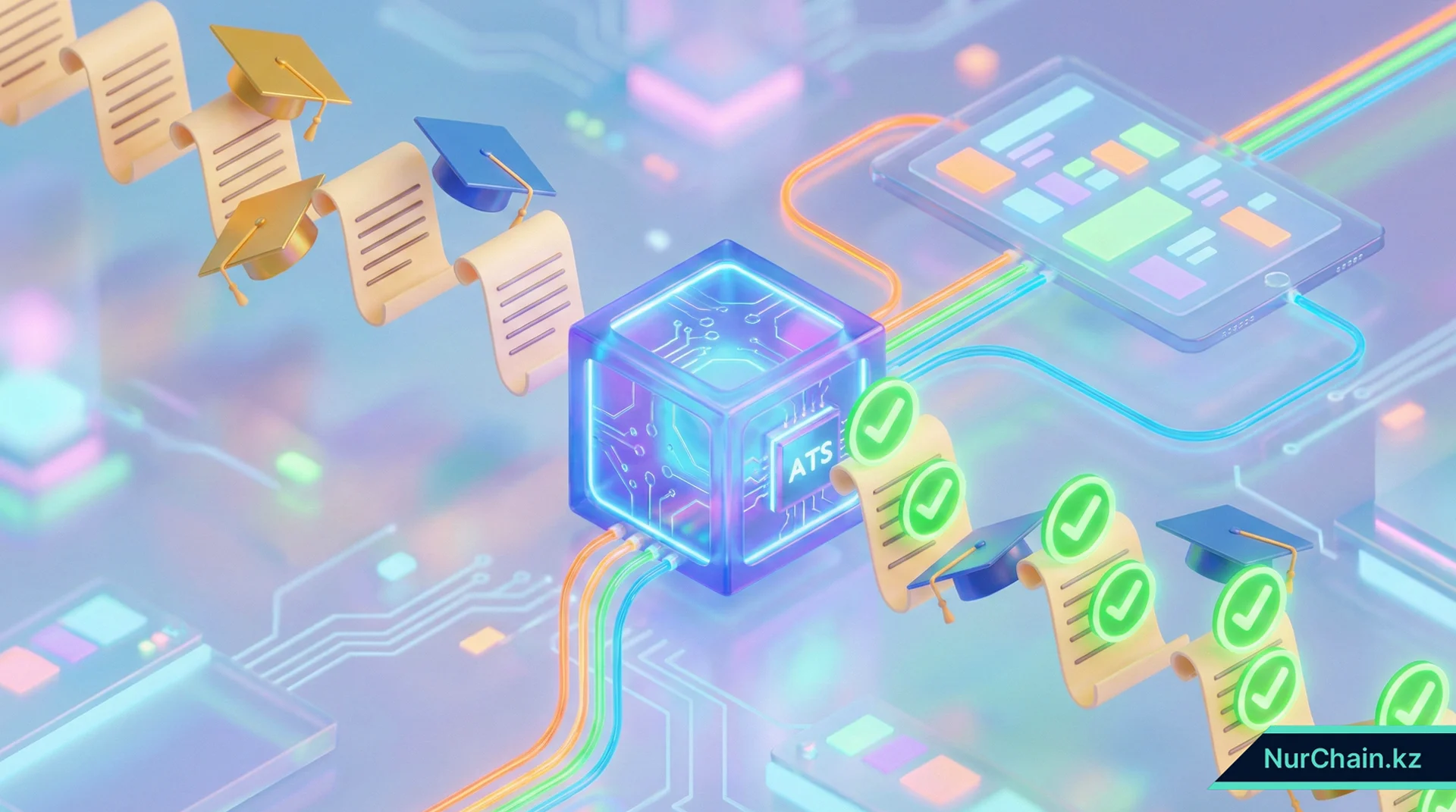
How do you actually bridge the gap between your traditional HR database and a decentralized ledger? This HR ATS integration forms the bedrock for modernizing blockchain in human resources . The "secret sauce" is a RESTful API layer-a digital translator that lets your software programs talk to each other over the internet. This layer connects your existing ATS-part of a global market heading toward $6.31 billion by 2033 -directly to the blockchain network where those NFT diplomas live. Think of it as a secure bridge where data flows safely between two very different worlds without any hiccups.
You need to set up a Middleware Validator-a software component that sits between applications to verify data-to make this work. It fetches the "Smart Contract" address and unique "Token ID," allowing your system to query decentralized ledgers instantly. How do smart contracts verify university degrees? It starts with the immutable ledger , which ensures every record remains permanent and unchangeable. This technology is becoming a staple of enterprise infrastructure as global integration budgets grow by 14% annually. To keep things lean, HR systems often use a Web3 Gateway like Infura or Alchemy to connect standard web apps to blockchain networks. This lets your software interact with the ledger without the massive overhead of maintaining your own full computer nodes. Gartner's 2024 Strategic Technology Trends highlight that "Digital Immune Systems" rely on this decentralized verification to protect corporate integrity and data provenance.
If you're operating locally, your system must handle JSON-LD formats so different machines can easily understand the data. This ensures your verified data doesn't sit in a silo, but stays compatible with over 1,000 third-party HR platforms and Kazakhstani government databases. It’s all about creating true interoperability for the 2026-era recruitment workflow so your tools talk to each other perfectly. This simplifies the path for Kazakhstani employers to verify international NFT degrees regardless of company size.
Quick Insight: You don't need to be a blockchain developer to use this technology. By using gateways like Infura, your company can plug into blockchain security while keeping the software interface exactly the same for the end-user.

How to Automate the Verification Workflow Within the ATS
What does this workflow look like in your daily life as a recruiter? You might be wondering how to integrate NFT diplomas into your existing ATS while searching for better applicant tracking system automation. It starts at the candidate submission stage. You simply update your ATS interface (your visual dashboard) to include a mandatory field for the candidate's public wallet address or a decentralized identifier (DID) link. This move makes perfect sense when you consider that 98% of Fortune 500 companies use ATS automation to handle massive application volumes. This shift uses decentralized identifiers (DID) for HR to give candidates full control over their own verified records.
The real magic happens during the triggered verification. Once a candidate hits the "Background Check" stage, your ATS automatically triggers an API call to validate the NFT’s status . This acts as a massive financial safeguard. It could save your organization from the $1.7 million average loss typically linked to occupational fraud cases. The system performs a metadata comparison, automatically checking attributes like the degree type and graduation year against the applicant’s profile. This high-speed digital degree verification ensures no fake credentials ever slip through the cracks. It directly solves a major pain point for the 78% of HR leaders currently struggling with inefficient manual resume screening.
Finally, everything stays visible on a status dashboard. The system dynamically generates a verification badge for you, providing a timestamped link to the transaction on a blockchain explorer . This ensures the total transparency that 75% of large enterprises now rely on for digital-first hiring. Just like that, you’re done.
Try This: Look at your current background check process. If it takes longer than 24 hours, you are losing top talent to faster competitors. Automation through NFT metadata comparison can turn that "days-long" process into a seconds-long confirmation .

Security and Legal Compliance for NFT-Based HR Data
Security remains the top priority for any tech rollout, especially when addressing FAQs for HR directors. In Kazakhstan, every digital integration must follow the Law of the Republic of Kazakhstan on Personal Data and its Protection . You likely wonder about the legal requirements for digital credentials in Kazakhstan and what data can employers see on an NFT diploma? Navigating regulatory compliance (GDPR, Kazakhstan Data Law) ensures users trust your system with their private info. To stay compliant, the system stores only the "Public Key" (a cryptographic code) in the ATS, while keeping sensitive, personal details encrypted off-chain. This "privacy-first" setup is vital now that 70% of companies face AI-generated fraud as a major operational threat.
Zero-Knowledge Proofs (ZKP) offer one of the most advanced ways to protect this information. This tech lets the ATS verify that a candidate definitely holds a specific degree without ever seeing or exposing their entire academic record. Think of zero-knowledge proofs in recruitment as the digital way to prove you're over 21 without showing your whole ID card. To keep everything locked down, organizations use Role-Based Access Control (RBAC) to ensure only authorized HR staff can view sensitive metadata.
Security isn't a "set it and forget it" task; it's a constant effort. Third-party security firms must audit the smart contracts used for NFT diplomas to block "Spoofing" and other cyber threats. This level of smart contract diploma validation requires a rigorous smart contract audit to make the code bulletproof. This defense is critical, as global cybercrime costs hit a massive $10.2 billion in 2024. Dr. Jane Smith, Cybersecurity Lead at the Global Institute for Tech Compliance, notes that cryptographic verification provides the foundation HR departments need to fight deepfake credentials. Can NFT verification prevent academic fraud? Absolutely-it makes forgery mathematically impossible. By combining audited contracts with local legal frameworks, you build a hiring process that is both cutting-edge and secure.
Did You Know?: Zero-Knowledge Proofs (ZKP) represent the gold standard for privacy. They allow you to be 100% certain a fact is true while sharing 0% of the candidate's private data , keeping you fully compliant with modern laws.

Summary: Streamlining Large-Scale Hiring with NFT-Powered ATS Integration
The big picture is clear. Integrating NFT-based verification into your recruitment process is much more than a simple tech upgrade. It represents a fundamental shift toward automated academic verification . This shift makes your organization significantly more agile. That means you stay quick and perfectly coordinated. The real value lies in dismantling manual bottlenecks. These slow processes usually drag down even the largest companies.
Moving to a blockchain-based model delivers incredible results for your organization. You can expect a massive 90% reduction in administrative costs. Even better, it shields you from the multi-billion dollar academic fraud market. A smart technical architecture makes this entire transition possible. Think of it as the core structural design of your system. It uses APIs to act as a high-speed bridge. This bridge connects your traditional HR databases directly to decentralized ledgers.
The practical beauty of this system is how it transforms the daily grind for your recruiters. It truly simplifies their working lives. We weave decentralized identifiers (DID) and metadata comparison directly into your ATS. This DID provides a new way to handle verifiable, decentralized digital identities. Once this is in place, the "background check" stage stops being a slow, manual chore. Instead, it becomes an automated trigger that delivers results in seconds.
Security and legal compliance remain vital priorities. This is especially true within the framework of Kazakhstan’s data protection laws. We use advanced methods like Zero-Knowledge Proofs (ZKP). This method allows one party to prove they know a value without actually sharing the data itself. Combining this with audited smart contracts lets you verify a degree with total precision. You can do this without ever exposing a candidate’s private information. As the case studies of Kazakhstani companies show, these pieces create a 100% digital audit trail . This doesn’t just speed up your "Time-to-Hire." It builds a foundation of unshakeable trust and integrity. That is exactly what you need in today's competitive, digital-first labor market.
🚀 Ready to scale your recruitment? Now that you understand the architectural bridge between your ATS and the blockchain, learn how to apply it at scale. Explore the mechanics of Batch Verification for Mass Hiring Campaigns to handle high-volume applicant pools instantly.
