Digital vs. Paper Diplomas: When to Use Each Version
 Author:
 Reading time:
11 min
Reading time:
11 min
 Difficulty:
Easy
Difficulty:
Easy
Ever caught yourself staring at that fancy paper diploma on your office wall? It’s a physical document awarded by your school, but here's the kicker: why do you still have to scan and upload a digital file for every single job application? It’s a common frustration we've all faced.
You have the physical proof right there, yet the modern professional world demands something much more high-tech. The truth is, we’re living in a transitional era where the "analog" charm of paper meets the "instant" demands of the internet. Knowing how to claim your NFT diploma and which version to use can be a total game-changer. It could be the deciding factor between landing that dream job or getting stuck in a bureaucratic loop.
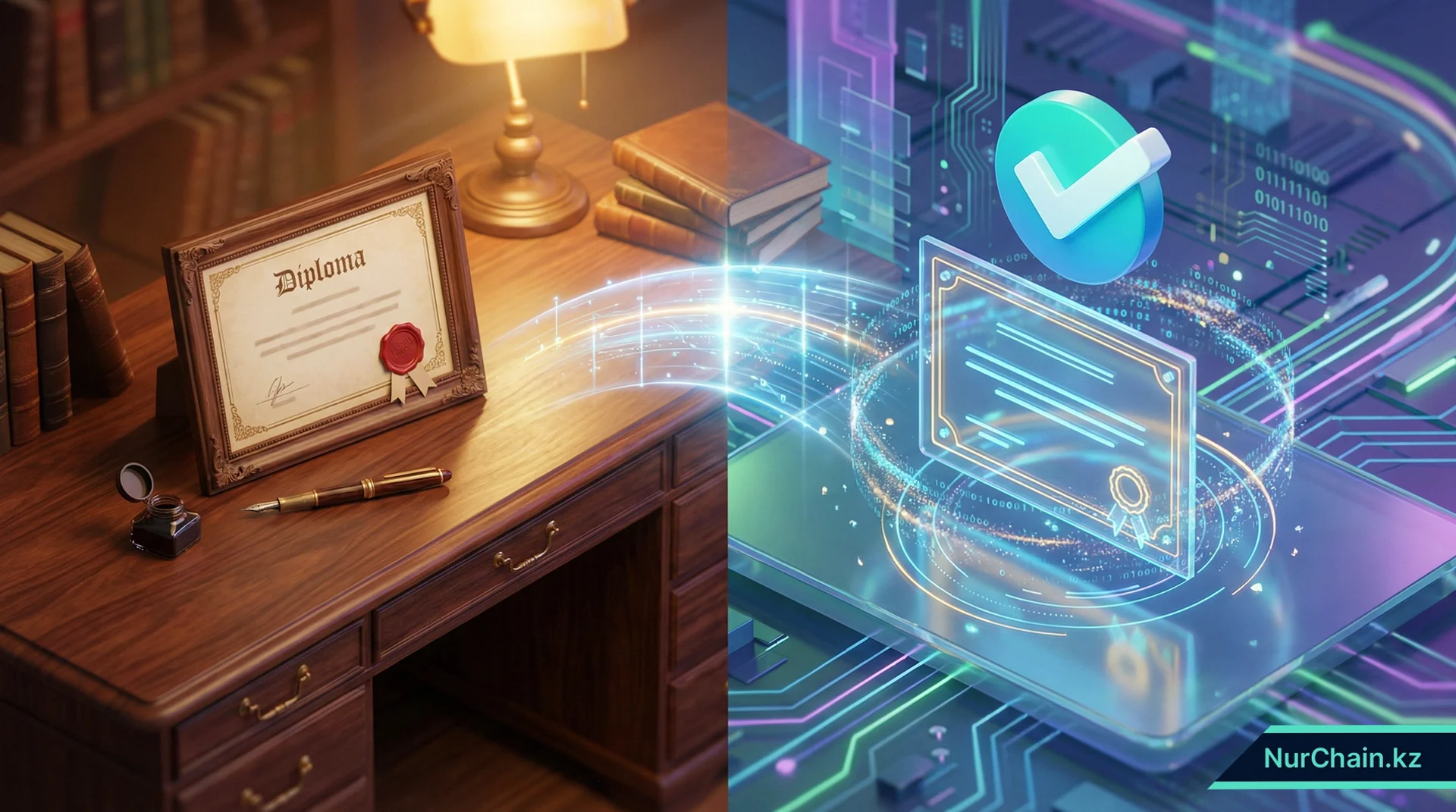
This shift is really a response to our need for speed and trust in a global market. These days, digital vs paper diplomas aren't really competing; they’re just serving different roles. We'll help you navigate this dual world and explore why digital credentials (electronic records of qualification) have become the 24/7 workhorse of your career. Because of true ownership, they are vital for your long-term growth. We'll also identify those high-stakes moments when only your physical, "wet-ink" diploma-the one with the original, handwritten signature-will do the trick.
🎓 Understanding the strategic balance between physical and digital formats is a key component of the Student Guide: How to Manage Your NFT Diploma.
Ever wondered why your physical diploma gathers dust in a drawer while your digital identity handles the heavy lifting for your career? In today’s fast-paced job market, the digital diploma has become the primary tool for 99% of daily administrative tasks. This shift is backed by serious capital; market research shows the digital credential management market hit a massive $2.29 billion in 2024 and analysts expect it to grow by 11.7% (CAGR) through 2029. This growth is largely driven by the adoption of Open Badges and W3C Verifiable Credentials standards , which ensure digital records are smart, machine-readable data sets rather than just static images.
Why the Digital Diploma is the Standard for Modern Applications
Applying for a new role? Time is everything. A digital credential allows for instant verification via cryptographic hashes on the blockchain. This means you slash the traditional verification cycle from five business days to near-instant results. By using blockchain technology, institutions provide a tamper-proof single source of truth. Administrative performance reviews show this represents a 60% improvement in efficiency. But it’s not just about speed; it’s about trust. Since 60% of job applicants currently misrepresent their qualifications, blockchain verified credentials provide a level of security that paper simply can't match. Automated verification reduces the risk of compliance errors, which is critical since hire-to-verify latency can cost firms thousands in lost productivity. This raises an important question for you: why is the digital diploma becoming the standard? Simply put, it solves the diploma verification process bottleneck by removing the need for slow, manual checks.
If you are looking at international opportunities, digital diplomas are a total game-changer, especially when you know how to share your NFT diploma with foreign universities. They bypass expensive, slow courier services, providing the interoperability needed to support a global e-learning market that reports now value at over $486 billion. Employer studies show that 75% of managers agree that digital micro-credentials for LinkedIn reflect your specific job readiness more accurately than broad academic transcripts . When you compare digital vs paper diplomas, the digital version wins on accessibility and speed every time. Integrating these into your LinkedIn profile isn't just a trend-it's a necessity for modern professional authority.
Quick Insight: Think of your digital diploma as your professional "fast pass." By using blockchain-verified credentials, you aren't just showing your degree; you're proving your integrity instantly to employers who are increasingly wary of resume fraud.

When Should You Use Your Physical Paper Diploma?
Does the rise of digital mean your paper version is obsolete? Not quite. Think of your paper diploma as a ceremonial artifact-a tangible symbol of your hard work. It still serves as a critical backup record. Security reports highlight a worrying trend: digital document forgeries jumped by 244% year-over-year in 2024. You might ask, "When should I use a physical paper diploma?" It remains vital for high-stakes legal scenarios where a wet-ink signature (a physical signature made with a pen) is non-negotiable. This surge in fraud leads some legal entities to still require physical watermarks (identifying patterns in paper that appear as various shades of lightness or darkness) to ensure physical diploma authenticity .
You also have to face the "human element" of bureaucracy. Certain government agencies or conservative licensing boards still mandate a physical apostille certification (a specialized certificate that authenticates the origin of a public document for international use). This caution stems from the rise of synthetic identity fraud (a type of fraud where criminals combine real and fake information to create a new, fictional identity) and deepfake (media that has been digitally manipulated to convincingly replace one person's likeness with another) attempts, which security firms saw occurring every five minutes in 2024. Despite high-tech security, you might still wonder, "What are the risks of digital document forgery?" and worry about sophisticated cyberattacks. Some jurisdictions hesitate to move to a purely digital-first workflow (the sequence of steps or tasks to complete a process). While the Hague Conference on Private International Law (HCCH) oversees the e-Apostille Pilot Program (e-APP, an initiative to create secure digital versions of document authentications), many member states still require physical seals for cross-border legal recognition.
While you might proudly display your diploma on your office wall, its role in actual verification is shrinking. Recruitment data suggests that employers ask only about 18% of job seekers for physical documents as primary proof today. Still, you may hit traditional requirements in the 39% of undergraduate environments that remain strictly conventional or in regions with developing IT infrastructure. Using the right format is key to credential fraud prevention in these specific contexts. In the rare event of a total digital failure, that physical paper remains your ultimate secondary proof, shielded from document degradation if stored correctly. It’s a low-tech safeguard against the rising cost of cyber-attacks (illegal attempts to damage or gain access to computer networks), which projections estimate will hit $10.5 trillion annually by 2025.
Why It Matters: Your physical diploma is your "analog insurance policy." While you likely won't use it for a standard job application, keeping it safe ensures you can navigate the 18% of scenarios where tradition and high-security legal checks still demand a physical touch .

How to Protect and Store Your Diplomas for the Long Term
Now that you know both are necessary, you need to keep them safe. Treat your physical version like a family heirloom. You might wonder, "How to protect physical diplomas from degradation?" and the answer is simpler than you think. Storing your paper diploma storage and protection in a fireproof, waterproof safe is the best way to prevent the natural document degradation (the breakdown or wearing away of material over time) that ruins paper records. This is vital as more institutions stop offering physical replacements, fueling a cloud-based records market that is growing at 12.6% annually.
Avoid handling the original paper often, as oils and moisture from your hands can damage the fibers over time. Instead, use a high-quality scan for any process that isn't digital-native (starting or existing naturally in a digital format). Remember, fraud detection statistics show that 4.5% of all documents globally are currently flagged for some form of manipulation. Having a pristine original is your best defense if your scan is ever questioned.
On the digital side, focus your maintenance on security and "data ownership." If you've asked yourself, "How do I store digital credentials securely?" the best approach involves encrypted storage. You should join the 75% of job seekers who now prefer using digital wallets (software-based systems that securely store information and digital assets) to manage their lifelong learning achievements. Treat these digital keys like financial assets because data breach costs are higher than ever. According to the latest cybersecurity benchmarks (standards used for measuring security performance), the average cost of a breach involving stolen credentials has risen to $4.88 million per incident. By regularly updating your contact information and securing your private keys (secure codes that allow users to access and manage their digital assets) so you never have to worry about what happens if you lost your crypto wallet, you ensure you remain part of the 94% of users who want full control over who can see your NFT diploma, ensuring your verified skills are shared securely with the global market.
Takeaway: Security is a dual responsibility. While a fireproof safe protects your past, a secure digital wallet protects your future. Taking five minutes today to secure your private keys could save you from becoming part of a multi-million dollar data breach statistic tomorrow.

Summary: Mastering the Balance Between Digital Speed and Physical Heritage
What’s the final verdict on the great diploma debate? The choice between digital and paper is simpler than you think. It isn't about one replacing the other. It’s really just about using the right tool for the job. The digital diploma has undeniably claimed its crown. It is now the go-to for modern career management.
What drives this shift? It’s driven by a massive $2.29 billion market and our collective need for instant verification . This is the immediate process of proving a document's authenticity. We achieve this using blockchain technology-a decentralized, distributed ledger that records transactions across many computers. We also use cryptographic hashes. These unique mathematical strings ensure your data integrity. Together, these tools solve that age-old headache of "waiting to be verified." In fact, they can cut wait times by as much as 60%. They provide a single source of truth . This data management principle means every piece of data is mastered in only one place. It’s something paper simply can't match in a fast-paced, global economy.
Whether you’re adding digital micro-credentials to LinkedIn or applying for a remote role halfway across the world, the digital version gives you the security you need to stand out. This is especially true now that resume fraud is on the rise.
However, don't throw away your paper diploma just yet. Think of it as your essential analog insurance policy . You might only need it in about 18% of modern hiring scenarios. However, its value skyrockets during those high-stakes legal moments. We're talking about things like getting an apostille certification . This specialized certificate authenticates the origin of a public document for international use. You might also deal with licensing boards. Many still insist on wet-ink signatures and physical watermarks. These identifying patterns in paper appear when you hold them up to the light.
Let’s be realistic. In an era of digital forgeries and cyber-attacks, things can get messy. Having a pristine physical backup is your ultimate defense. The best strategy is simple. Treat your paper diploma like a protected heirloom in a fireproof safe. On the other hand, keep your digital assets ready in one of the best mobile apps for storing and sharing your digital credentials. This software-based system stores your digital credentials and assets . That way, your hard-earned qualifications are always ready to go. It doesn't matter if you're clicking "apply" on a new opportunity or troubleshooting a technical issue. You'll be just as prepared if you're proving your credentials in a court of law .
🚀 Ready to take action? Now that you understand why the digital version is your daily workhorse, learn the practical steps to secure yours. Follow the guide on How to Claim Your NFT Diploma to start building your digital professional identity.
