The Future of Decentralized Academic Transcripts on Blockchain
 Author:
 Reading time:
13 min
Reading time:
13 min
 Difficulty:
Easy
Difficulty:
Easy
- Why Granular On-Chain Grade Verification is the Next Frontier
- How Blockchain Eliminates the $3 Billion Global Cost of Credential Fraud
- Transforming the Registrar’s Office: From Manual Delays to 95% Efficiency
- Empowering Students through Self-Sovereign Identity and Data Ownership
- Real-World Implementation: From Kazakhstan’s IITU to Global Standards
- Summary: Redefining Academic Trust and Student Empowerment Through Blockchain
Look at your hard-earned diploma and you'll realize it only tells a tiny fraction of your story. In a world that runs on data, a static piece of paper feels like a relic from a different era. Even a basic PDF doesn't cut it anymore. It's frustrating when a certificate can’t easily prove your skills or show the specific things you mastered.
This "trust deficit" creates a massive gap in confidence regarding the authenticity of records. This is exactly why the Blockchain in EduTech Market is exploding right now. Educational institutions are scrambling to find more secure, modern ways to validate your achievements.
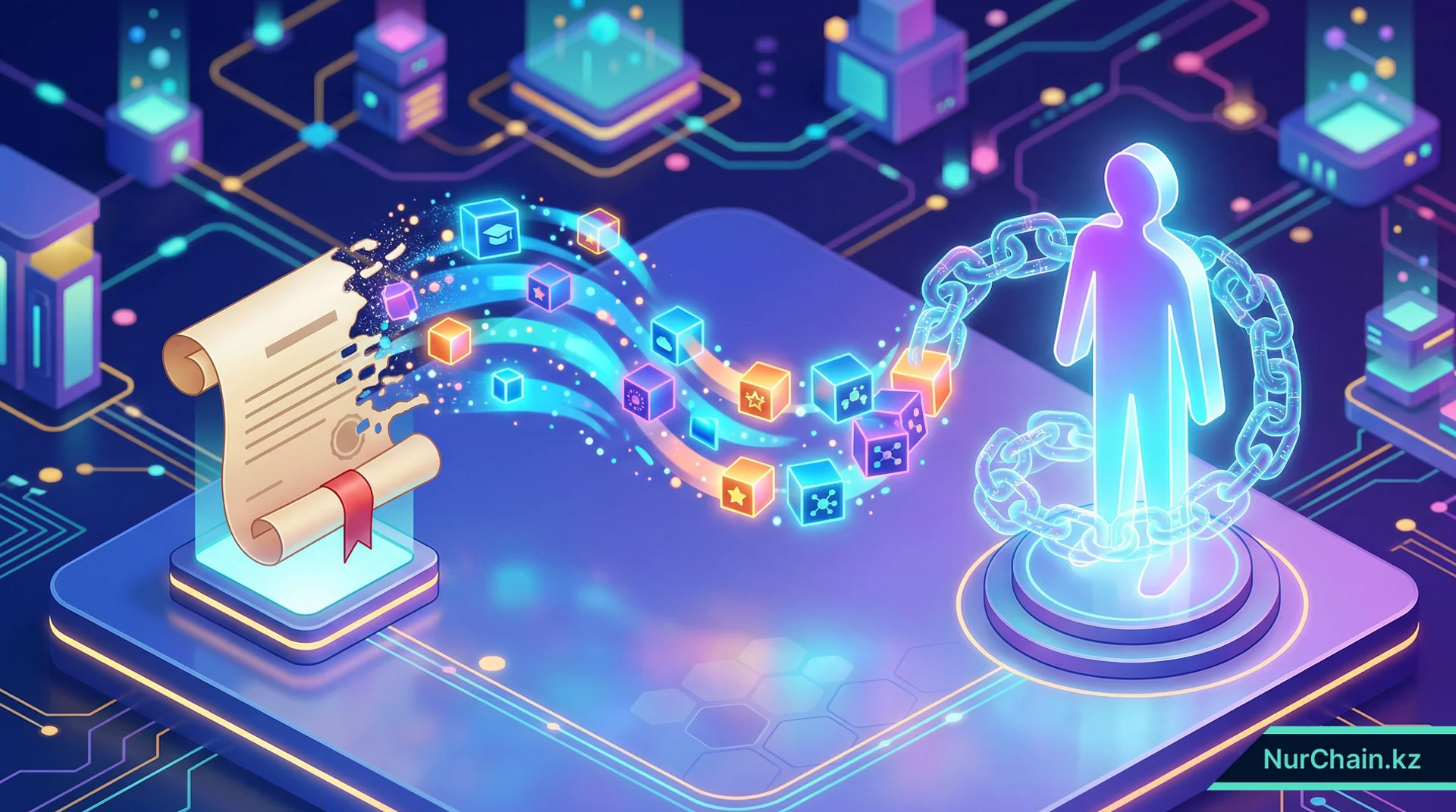
The strategic answer? It's granular on-chain grade verification . This process records your individual academic results directly onto a blockchain. Think of it as a transparent, decentralized digital ledger that tracks every academic milestone you reach. This provides instant, undisputed proof of your hard work.
By shifting to this model, we aren't just digitizing paper certificates. Instead, we’re creating a more honest and efficient path for your career. Blockchain is dismantling the $22 billion fraud market and revolutionizing university administration. Most importantly, it gives you total ownership of your digital identity. This technology truly puts you in control.
🏗️ Establishing granular, on-chain verification for transcripts is a vital architectural step within the broader vision of The Future of EdTech in Kazakhstan.
Why Granular On-Chain Grade Verification is the Next Frontier
Have you ever stopped to think about why a traditional degree certificate only tells a tiny fraction of your story? Usually, it’s just a formal piece of paper stating you graduated, but it often misses the nuance of how you actually performed or what you truly mastered. We are entering an era where granular data -highly detailed information broken down into specific parts-is the new gold standard. In fact, the Blockchain in EduTech Market isn’t just growing; it’s exploding right before our eyes. It is projected to skyrocket from $2.39 billion in 2025 to $22.31 billion by 2035, maintaining a massive 25.01% CAGR (average annual growth rate). You might wonder, why is the blockchain in EduTech market growing so fast? The answer lies in its ability to solve the trust deficit that plagues modern education. According to Grand View Research, the increasing need for secure, transparent record-keeping systems that handle complex academic data points drives this expansion. So, what is granular on-chain grade verification? Essentially, it is the process of recording every single achievement on a public ledger to ensure total transparency for everyone involved.
Why is this happening right now? The stakes for you and your future employers have never been higher. In 2024 alone, we saw a 244% year-over-year increase in digital document forgeries. To fight back, institutions are moving beyond the "final certificate" and are instead anchoring individual course grades and credits directly to the blockchain. Take the University of Glasgow, for example. They have already prototyped systems using Ethereum-a decentralized blockchain with smart contract functionality-to store individual student grades. This isn’t just a technical experiment; it’s a necessity for a global market where 65% of GDP is expected to be digitalized by 2030.
This shift perfectly supports the rise of micro-credentials and nanodegrees and MOOCs (Massive Open Online Courses). Think of it as building a digital Lego set of your education-you can aggregate verifiable "learning blocks" into one cohesive, interoperable transcript that recruiters actually trust. This precise granular transcript verification allows employers to see exactly where you shine. And for those worried about privacy? Advanced tech like Zero-Knowledge Proofs (ZKP) allows you to prove you "scored above 90% in Advanced Mathematics" without revealing your entire life story. This is a huge relief, considering that 68% of adults worldwide voiced serious concerns about personal data misuse in 2024.
Quick Insight: Granular verification means you aren't just a degree holder anymore; you are a collection of verified skills . This level of detail makes it nearly impossible for your hard work to be overlooked by automated hiring systems.

How Blockchain Eliminates the $3 Billion Global Cost of Credential Fraud
Imagine a world where a "deepfake" (digitally altered media where a person's likeness replaces someone else's) steals a job you’re actually qualified for. It’s a scary thought, but the 2025 Identity Fraud Report reveals that sophisticated document manipulation and deepfake attempts now happen every five minutes. This creates a massive hole in the economy, fueling a $22 billion global academic fraud market. When you look at the big picture, how does blockchain eliminate academic credential fraud? It works by creating a system where every certificate links uniquely to its issuer, making digital document forgery prevention a standard feature rather than an afterthought.
Blockchain acts as your shield. By creating an immutable (unchangeable) "audit trail" (a step-by-step record providing evidence of activities), we replace those easily forged static PDFs with cryptographically secured assets. This transition alone could slash document fraud cases by up to 90%. This leads to significant credential fraud cost reduction because the need for manual oversight simply vanishes. It’s why Deloitte highlights that decentralized records are 80% more secure than the old-school centralized databases (systems where data stays in one single location) we’ve used for decades-systems constantly at risk of hacks or "inside jobs." By converting degrees into tamper-proof digital assets , we ensure their value stays intact for a lifetime. "Blockchain’s decentralized nature ensures that no single point of failure exists, making it virtually impossible for unauthorized parties to alter academic records," notes a security analysis by Gartner.
For companies, the current reality of manual background checks is a slow-motion nightmare. Right now, verifying a credential takes an average of 94 days. Many hiring managers ask: can blockchain reduce the cost of background checks? The data says yes, as removing the manual verification layer saves both time and money. By switching to blockchain-based transcripts, you can drop that timeline to less than one week-and often to just a few seconds. When authenticity is baked into the digital asset, it creates a single source of truth (a model where every data element exists in only one place) that improves employer trust by 30%.
Why It Matters: When you automate trust, everyone wins. Employers hire faster with 100% confidence, and honest graduates don't have to compete with "bought" diplomas from across the globe.

Transforming the Registrar’s Office: From Manual Delays to 95% Efficiency
Have you ever called a registrar’s office to request a transcript? Then you know the "waiting game" all too well. For universities, this isn't just a customer service headache; it's a massive financial drain. Boosting blockchain registrar office efficiency isn't just about speed-it’s about reclaiming hours that staff could spend actually helping students. How do universities benefit from decentralized transcripts? You get a robust, automated system that runs without constant human intervention. Right now, manual verification devours about 38% of total operational budgets in many institutions. But what if you could automate the boring stuff?
Blockchain systems can slash these administrative costs by 20% through simple automation. Take the University of Bahrain , for example. By moving their transcripts to a decentralized ledger (Hyperledger Fabric), they didn't just see a minor tweak-they saw a 72% reduction in credential verification costs . Most institutions choose between Ethereum and Hyperledger Fabric depending on whether they need a public or private setup for their records. They managed to slash processing times from a grueling 28 days down to just 4 hours.
Research into modified blockchain architectures shows a system efficiency of 95.2% for handling issuance and verification requests. This means that even during the graduation rush, you won't hit any "bottlenecks." PwC reports that this ripple effect improves overall hiring efficiency by 70% for the rest of the world. By using smart contracts for academic data , the system triggers academic integrity automation, which leads to a massive administrative bottleneck reduction during peak seasons. This cuts out the middle-man, letting your staff focus on what actually matters: student success.
Takeaway: Efficiency in the registrar's office isn't just about saving money; it’s about moving at the speed of the modern world. Why wait a month for a signature when a smart contract can do it in seconds?

Empowering Students through Self-Sovereign Identity and Data Ownership
Who actually owns your education? Traditionally, the university does. But that is changing fast. The massive shift toward Self-Sovereign Identity (SSI) -a market that hit $1.1 billion by 2024 with a staggering 90.5% CAGR-is putting power back in your hands. By using Decentralized Identifiers (DIDs) to create a unique digital presence, you gain full control over your records without relying on a central authority. In this new model, you are the owner. Your records live in a secure digital wallet that you carry with you for life.
This is a game-changer for lifelong access. This approach ensures strict data ownership and privacy because you-not the institution-decide who sees your sensitive info through digital student wallets. If a university closes down-and it happens more than you’d think-your records don't vanish. More than 250 institutions worldwide already use BCdiploma’s blockchain tech to ensure these records last forever. In a 2024 survey at the University of Lille, 81% of students called these certificates vital for their career. Plus, the school saved 7 days of paperwork for every 2,000 diplomas they issued.
Even the European Commission is moving toward a digital "student passport" initiative. They found that decentralized records cut processing time by 60% for students moving between countries. What are the advantages for you? Beyond portability, it offers total peace of mind. For instance, Zero-Knowledge Proofs allow you to prove your GPA or degree without oversharing personal details you want to keep private. Because these credentials are tamper-proof , you can share them directly on LinkedIn. These verified digital assets get much more attention than a blurry scan of a paper document ever could.
Did You Know? Self-sovereign identity means you never have to ask permission to prove you graduated. You hold the keys to your own data, and you decide who gets to see it.

Real-World Implementation: From Kazakhstan’s IITU to Global Standards
This isn't just a Silicon Valley or London trend. In Kazakhstan, the International IT University (IITU) in Almaty leads the charge. They pioneer simulations using Ethereum-based blockchain to verify academic integrity, ensuring Kazakhstani education stays on the cutting edge of verifiable credentials. By using decentralized grade verification, the university makes sure on-chain academic records are accessible anywhere in the world. This move aligns perfectly with the "Digital Kazakhstan" state program and the 10-year roadmap for digital education, which aims to weave advanced tech into the national infrastructure to boost quality and transparency.
The IITU model is technically robust. It uses the SHA3-512 cryptographic hashing algorithm -a secure function that turns data into a unique digital fingerprint-to lock in academic records. Once you commit a transcript to the ledger, it stays there forever-honest and unalterable. These blockchain academic transcripts effectively validate micro-credentials on blockchain, which are surging in popularity across the tech industry. It's a powerful local response to the high academic fraud rates currently reported across Asia.
IITU sits in good company. Global giants like MIT, Harvard, and the National University of Singapore have already set the "digital-first" standard. By adopting W3C Verifiable Credentials standards, Kazakhstani graduates ensure international employers instantly recognize their grades. Students often ask: what’s the difference between a static PDF and a blockchain transcript? While you can easily edit a PDF, a blockchain record links mathematically to the source, making it impossible to fake. The future of EdTech in Kazakhstan involves exploring the synergy of ai and blockchain to spot any anomalies-those odd patterns that deviate from the norm-in achievement data. In a world where transparency and trust are the most valuable currencies, these digital transcripts are the keys to the kingdom.
Pro-Tip: If you're a student or a professional, look for institutions that offer blockchain-verified credentials. It's the simplest way to future-proof your resume for the international job market.

Summary: Redefining Academic Trust and Student Empowerment Through Blockchain
The transition to decentralized academic transcripts signals a massive shift from a broken, paper-based past toward a secure, digital-first future. This entire movement addresses an urgent need to fix the trust crisis in education. With a massive $22 billion academic fraud market thriving today, traditional verification has become slow and unreliable. It is a persistent headache for everyone involved.
By implementing granular on-chain grade verification , universities are finally moving beyond simple completion certificates. You now receive a detailed, tamper-proof record of every single credit you’ve earned. This doesn't just protect your degree's value; it actively stops digital document forgery -the unauthorized creation or alteration of files-dead in its tracks.
The system relies on immutable ledgers , which are digital records that no one can change, and cryptographic hashing. This security process turns your data into a unique string of characters. Once the system records an achievement, it stays there for good, meaning no one can ever alter or fake it.
The benefits of this technological leap reach far beyond security, offering a huge win for administrative efficiency. Institutions now automate the verification process through smart contracts for academic data , which are self-executing digital agreements with terms written directly into code. Forward-thinking schools like the University of Bahrain and Kazakhstan’s IITU already lead the way, proving we can slash wait times from months to mere seconds.
This effectively clears out the "bottlenecks"-those frustrating points of congestion-that usually plague registrar offices. For you, this means a much smoother experience when you apply for jobs. Employers can now verify your specific learning blocks , or discrete units of achievement, with total confidence.
The most important takeaway? Power is shifting back to you thanks to the rise of Self-Sovereign Identity (SSI) . This model gives you full control over your digital identity without any need for central authorities. With this and a secure digital wallet, you gain the freedom to own your data for life without relying on your alma mater to prove your qualifications.
You can even use privacy-preserving tools like Zero-Knowledge Proofs , a cryptographic method that lets you prove a statement is true without revealing any extra information. You share only what is necessary for a job or a transfer. By embracing these decentralized records, we are building a world where your hard-earned skills are genuinely portable, instantly verifiable, and entirely under your control.
🚀 Ready to take control? Once your academic records are decentralized and tamper-proof, you need a secure way to manage them. Discover how to own your professional identity through the Skills Wallet Concept.
