Beginner's Guide to Crypto Wallets for University Students
 Author:
 Reading time:
15 min
Reading time:
15 min
 Difficulty:
Easy
Difficulty:
Easy
Imagine it’s a decade from now. You’ve just landed an interview for your dream job. But when the moment arrives to prove you actually have your degree, things go wrong. You realize the university’s old records portal is offline. Or maybe that student email you used was deactivated years ago. It’s a total "digital-age" nightmare-and honestly, it happens more often than you’d think. This usually happens because we've been trained to let institutions hold the keys, giving them control over your hard-earned achievements.
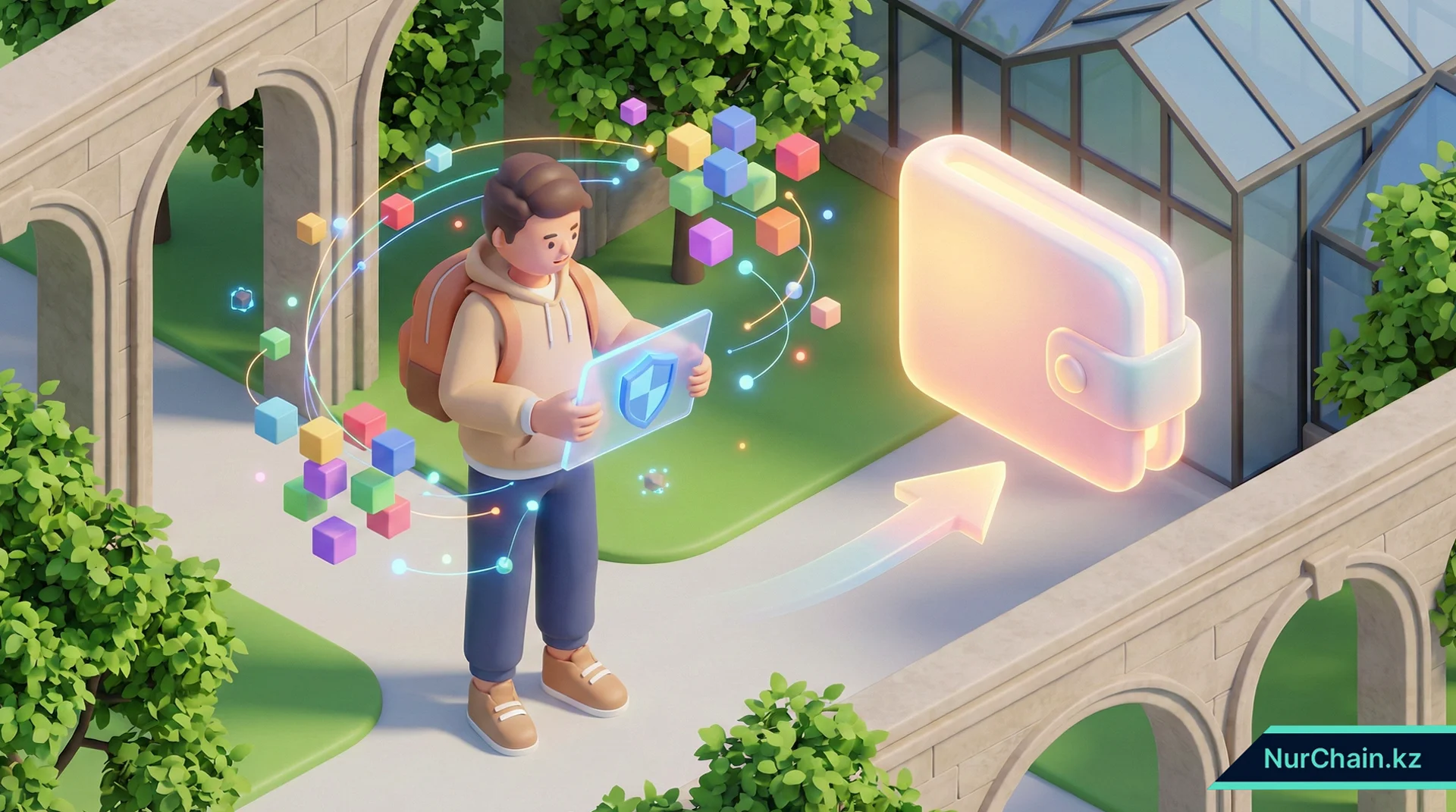
That’s precisely why choosing between custodial vs non-custodial wallets for students is so important. It has become arguably the most important "elective" you’ll ever take. Look at it this way: a crypto wallet isn’t just a digital purse for money; it’s your lifelong academic passport. In simple terms, it’s a secure interface that allows you to manage your private keys. These are unique digital codes that act like a signature, giving you true ownership of your NFT diploma and ensuring it lasts forever. You won’t need a middleman’s permission.
This guide is here to help you navigate this new world. We'll show you how to claim your NFT diploma after graduation and reclaim your data sovereignty -the right to control your own digital information. We'll also help you figure out which mobile apps for storing and sharing your digital credentials actually fit your career path, including options like MetaMask or Phantom. Finally, we’ll walk through the essential security habits you need to keep your academic identity safe for the next fifty years.
📘 Selecting and securing a crypto wallet is the essential technical starting point for the comprehensive strategy found in the Student Guide to Managing NFT Diplomas.
Why the Choice Between Custodial and Student-Owned Wallets is Critical
Think of your crypto wallet as more than a digital purse; it's your lifelong academic passport. Understanding the choice between custodial and non-custodial wallets is your first step toward protecting your academic future. As you begin collecting digital credentials, you’ll face a big question: who really holds the keys? A custodial wallet works like a standard bank account where a third party-like your school or an exchange like Coinbase -manages your private keys for you. What is the difference between custodial and non-custodial wallets? It boils down to whether you hold the keys to your own front door or let a bank manage a safe deposit box for you. While convenient, this setup clashes with the global shift toward data autonomy. The crypto wallet market is exploding, set to reach $25 billion in 2026 as people demand total control over their assets.
When you choose a non-custodial wallet, you hold the private keys yourself. Why is self-custody important for university students? Because it turns you from a passive user into the active guardian of your own success. These cryptographic proofs empower the 13.29% of the global population already active in the digital asset economy. Without these keys, you’re technically just a "data subject" waiting for someone else’s permission. By holding them, you become a true data owner . Self-custody for student records ensures your diplomas are assets you own, not just lines in someone else's database. This is the core of data sovereignty and ownership , where you understand who can see your NFT diploma and call the shots on sharing. The numbers tell the story: with over 560 million owners worldwide, decentralized identity is the new standard. This is especially true for the 31% of owners aged 25–34 who want portable records instead of files locked in institutional silos.
For a student, a custodial wallet might feel like the "easy" button, but it brings a major institutional lock-in risk. If your university changes tech providers or you lose your student email after graduation, you could lose access to your NFT diploma . This is a huge risk in a market growing at a CAGR of 31.9% through the end of the decade. According to the 2024 "Global Blockchain in Education Report," moving to Self-Sovereign Identity (SSI) can slash verification costs by 80% while giving you more agency. Essentially, non-custodial wallets enable Self-Sovereign Identity (SSI) . Knowing when to use digital vs paper diplomas ensures your achievements stay in your pocket forever, no matter what happens to the school. It’s a vision shared by the 52% of wallet users with advanced degrees who demand that their credentials work everywhere.
Why It Matters: Choosing a non-custodial wallet is about future-proofing your career. It ensures that ten years from now, you won't need to ask permission from a former registrar just to prove you graduated.

Do You Need MetaMask for Your NFT Credentials?
If you’ve spent more than five minutes researching crypto, you have almost certainly heard of MetaMask . When looking for the right MetaMask for student credentials , you're joining a massive network of users who value its integration with almost every major Web3 platform. It remains the industry standard for Ethereum-based credentials, boasting approximately 30 million monthly active users (MAUs) in 2026. Many students ask, "Do I need MetaMask to view my academic credentials?" While it's a popular choice, it is certainly not the only window into your digital trophy case. For most students, it serves as the primary gateway to decentralized applications (dApps) (software programs that run on a blockchain instead of a single computer) that modern employers use to verify verifiable credentials (digital documents that prove a person's identity or achievements in a secure and tamper-proof way). These Verifiable Credentials (VCs) are the gold standard for proof-of-achievement today. To stay relevant, MetaMask has expanded significantly, now supporting Solana and Bitcoin directly to help reduce the frustration of managing multiple apps.
Is it the only choice? Not necessarily. Trust Wallet is a massive alternative that surpassed 220 million users in late 2025. It offers a highly visual interface that is arguably much better for viewing and sharing your NFT diploma with foreign universities compared to MetaMask’s more technical layout. Analysts at Messari note that this diversification reflects a broader move toward a multi-chain ecosystem where blockchain interoperability (the ability of different blockchain systems to communicate and share data with each other) is the primary value driver for users. If your specific university leverages the Solana blockchain-which was handling over 2.3 billion on-chain transactions (data exchanges recorded directly on the blockchain) monthly by late 2025-then Phantom Wallet is your essential choice. If you're wondering which crypto wallet is best for Solana-based credentials, Phantom’s smooth mobile experience often wins out. Choosing between Phantom Wallet vs Trust Wallet for NFTs usually comes down to whether you prioritize the Solana ecosystem or a broader multi-chain approach. It caters to students who need high-speed confirmations and do not want to spend their lunch money on gas fees and transaction costs (the transaction costs required to process operations on a blockchain).
While MetaMask is free for holding your diploma, it does charge a 0.875% fee on internal token swaps (the process of exchanging one type of cryptocurrency for another within the app). The underlying NFT metadata and smart contracts (the technical components that manage ownership and information) handle the heavy lifting of proving that your degree is the real deal. Despite this, the platform remains a favorite entry point for the 20% of global crypto users aged 18–24 because of its reliability. Most student-focused platforms today are EVM-compatible . In plain English, this means a single wallet address can work across Polygon, BNB Chain, and Ethereum (since these networks are compatible with the Ethereum Virtual Machine (EVM) (the software environment where all Ethereum accounts and smart contracts live)). This makes it much easier to manage EVM-compatibility for digital badges without needing a different setup for every single school project. You might find yourself asking, "Can I use the same wallet for different blockchain networks?" In the EVM world, the answer is a resounding yes. This kind of interoperability is crucial; as decentralized finance (financial services built on blockchain technology) and education continue to merge, you will want a wallet that can jump between different networks without breaking a sweat.
Quick Insight: You do not have to pick just one. Because many wallets are compatible with the same "seed phrase" (a series of words that acts as a master key to recover a crypto wallet), you can often view the same academic assets in MetaMask on your laptop and Trust Wallet on your phone.

Selecting a Wallet Based on Security and Career Longevity
Choosing a wallet is a lot like picking a car-you need to balance daily ease of use with rock-solid safety. While navigating the world of crypto wallets for university students requires some research, think of it as a vital investment in your future self. Coinbase Wallet -the independent, non-custodial app-currently serves over 3.2 million monthly active users (MAUs) and consistently ranks as the "Best for Beginners." It simplifies private key management for beginners, stripping the intimidation factor out of the setup process. This tool bridges the gap for the 120 million verified users on the main exchange, making the transition from a standard account to true ownership feel completely seamless.
If you're a student who prioritizes maximum security or worries about losing passwords, Zengo might be your best bet. It protects over 900,000 customers using Multi-Party Computation (MPC) (a cryptographic method that allows multiple parties to jointly compute a function while keeping their inputs private) technology. This is a total game-changer because it removes the "seed phrase" (a series of words that acts as a master key to recover a crypto wallet) requirement, eliminating a major single point of failure (a part of a system that, if it fails, will stop the entire system from working). This tech represents a massive leap forward in securing digital academic credentials without the stress of losing a single piece of paper. However, if your NFT diploma represents a high-value certification like a Medical Degree, you should look toward the institutional benchmark: hardware wallets (Ledger, Trezor). Investing in cold storage for high-value degrees is a smart move for anyone entering a field where professional standing is everything. These devices keep your private keys entirely offline, far away from browser-based malware (malicious software designed to damage or gain unauthorized access to a computer system). "Hardware-based cold storage (a method of keeping digital assets in an offline environment to prevent hacking) remains the gold standard for securing high-stakes digital assets," notes Dr. Sarah Miller, a senior researcher at the Blockchain Security Institute. For many, these devices are the best wallet for NFT diplomas because they offer a level of peace of mind that software-only solutions simply can't match.
If you want a premium experience on both desktop and mobile, Exodus manages over 300 cryptocurrencies and offers a beautiful interface for displaying an academic portfolio (a collection of digital credentials and achievements) on high-resolution screens. The biggest advantage of any of these non-custodial options is that you bypass the intrusive Know Your Customer (KYC) (a mandatory process for financial institutions to verify the identity of their clients) requirements often found in custodial systems. This gives you immediate, permissionless (meaning no central authority is required to grant access) access to your credentials. At the same time, you maintain the tamper-proof (designed so that any attempt to alter the data is easily detected) integrity of your professional identity.
Takeaway: Your wallet choice should match the "value" of what you are holding. A simple app is fine for a basic certificate, but once you've earned your degree, you'll want to know how to add your NFT diploma to your LinkedIn profile to ensure you get maximum professional visibility.

Essential Practices for Protecting Your Digital Academic Identity
The digital world is a wild place. With crypto theft reaching $3.4 billion in 2025, you must treat your 12 or 24-word seed phrase as the master key to your entire professional history. Many beginners panic and ask: What happens if I lose my crypto wallet seed phrase? The harsh reality? Without it, you could be locked out of your credentials forever. This is why having a clear plan for seed phrase recovery is non-negotiable. Personal wallet compromises now account for roughly 37% of all stolen value. If someone gets your seed phrase, they don’t just get your money-they effectively become the owner of your academic identity.
One rule stands above all: never store your seed phrase in a digital format. That means no screenshots, no emails, and no cloud notes. Is it safe to store a phrase on a phone or computer? The answer is a firm no-hackers look for these specific strings of words first. Even with the rise of AI-driven security, physical, offline storage remains your only defense against the remote exploits that targeted over 158,000 individual wallets last year. Prioritizing seed phrase security (offline storage) -like writing it on a piece of paper and locking it in a drawer-is your best move. You also need to stay vigilant against phishing and malware protection schemes that try to trick you into revealing your secrets. You should also make two-factor authentication (2FA) and biometric security layers a standard part of your routine. Currently, over 84% of mobile wallet apps use these features to protect you against device theft.
Finally, watch where you log in. Avoid using public university Wi-Fi when managing your academic assets. Using a VPN or your own mobile data is a simple way to stop "man-in-the-middle" attacks. How can you prevent your digital identity from being hacked? The answer usually lies in these simple, consistent habits. It is also wise to regularly update your software to use the latest security scanners . For example, the scanner in Trust Wallet blocked over $191 million in scam transactions in 2025 alone. As the market moves toward even more robust MPC-based and biometric architectures, staying updated is your best defense.
Did You Know?: Most wallet hacks are not technical breaches of the blockchain; they are social breaches. Treat your phrase like your social security number-never share it with anyone.

Summary: Taking Charge of Your Digital Academic Legacy
Bottom line? Your wallet choice matters. The crypto wallet you pick determines who actually controls your professional future. You'll find a massive difference between custodial and non-custodial wallets . It really comes down to whether you're a "data subject" or a data owner . Data subjects let others hold their information. They have to ask for permission just to use it. A data owner, however, holds all the power.
When you embrace self-custody for student records , you join a global movement. You're personally holding and protecting your digital assets. This movement pushes toward Self-Sovereign Identity (SSI) . In this model, you have full control over your digital identity. What does this mean for you? It's simple. Your NFT diplomas and verifiable credentials become portable and permanent. These digital proofs of achievement stay with you forever. They also break you free from institutional lock-in. You'll never be stuck with a single provider's closed system. This isn't just about following a trend. It’s a smart, strategic move to protect your hard work. It shields you from changing tech providers or administrative red tape. Plus, it saves you and your future employers a massive amount of time. It also slashes verification costs down the road.
The tools you pick to manage this identity must align with your career goals. You might choose the wide EVM-compatibility of MetaMask. This is the ability to work seamlessly across the Ethereum Virtual Machine ecosystem. You might prefer the multi-chain versatility of Trust Wallet. Or perhaps you like the lightning-fast feel of Phantom. While software wallets offer great convenience, degrees are far too valuable to risk. The "gold standard" for a degree remains hardware-based cold storage . These physical devices keep your records offline. You could also explore advanced MPC technology. Multi-Party Computation removes the risk of a single point of failure.
By committing to solid seed phrase security , you’re doing much more than just managing a wallet. This series of words is what you use to recover your wallet. By avoiding common digital storage traps, you’re safeguarding your hard-earned reputation. Think of this guide as your foundation for a new era. We've entered a time where your skills are your greatest asset. Your wallet acts as a secure, tamper-proof vault. It carries those skills wherever your career leads, and if you hit any technical hurdles, check out our guide on troubleshooting common NFT diploma issues.
🚀 Ready to use your wallet? Now that you understand the mechanics of self-custody and security, it's time to put that knowledge into action. Discover How to Claim Your NFT Diploma After Graduation to officially secure your credentials.
