Blockchain for HR Directors: Top Frequently Asked Questions (FAQ)
 Author:
 Reading time:
13 min
Reading time:
13 min
 Difficulty:
Easy
Difficulty:
Easy
- How Reliable Is Blockchain for Verifying Professional Credentials?
- Is Blockchain-Based Credentialing Compliant with GDPR and Legal Standards?
- What Are the Long-Term Access and Longevity Guarantees for These Records?
- What Is the Actual ROI and Cost-Efficiency for HR Departments?
- Summary: Transforming Talent Acquisition with a Blockchain-Backed Foundation of Trust
Have you ever stared at a candidate’s stellar resume and felt a nagging doubt? Is it just a bit too good to be true? You're definitely not alone. Today, AI can polish up documents in seconds, and digital forgeries have surged by over 200%. Because of this, that "perfect" CV often feels more like a facade than a real record of success.
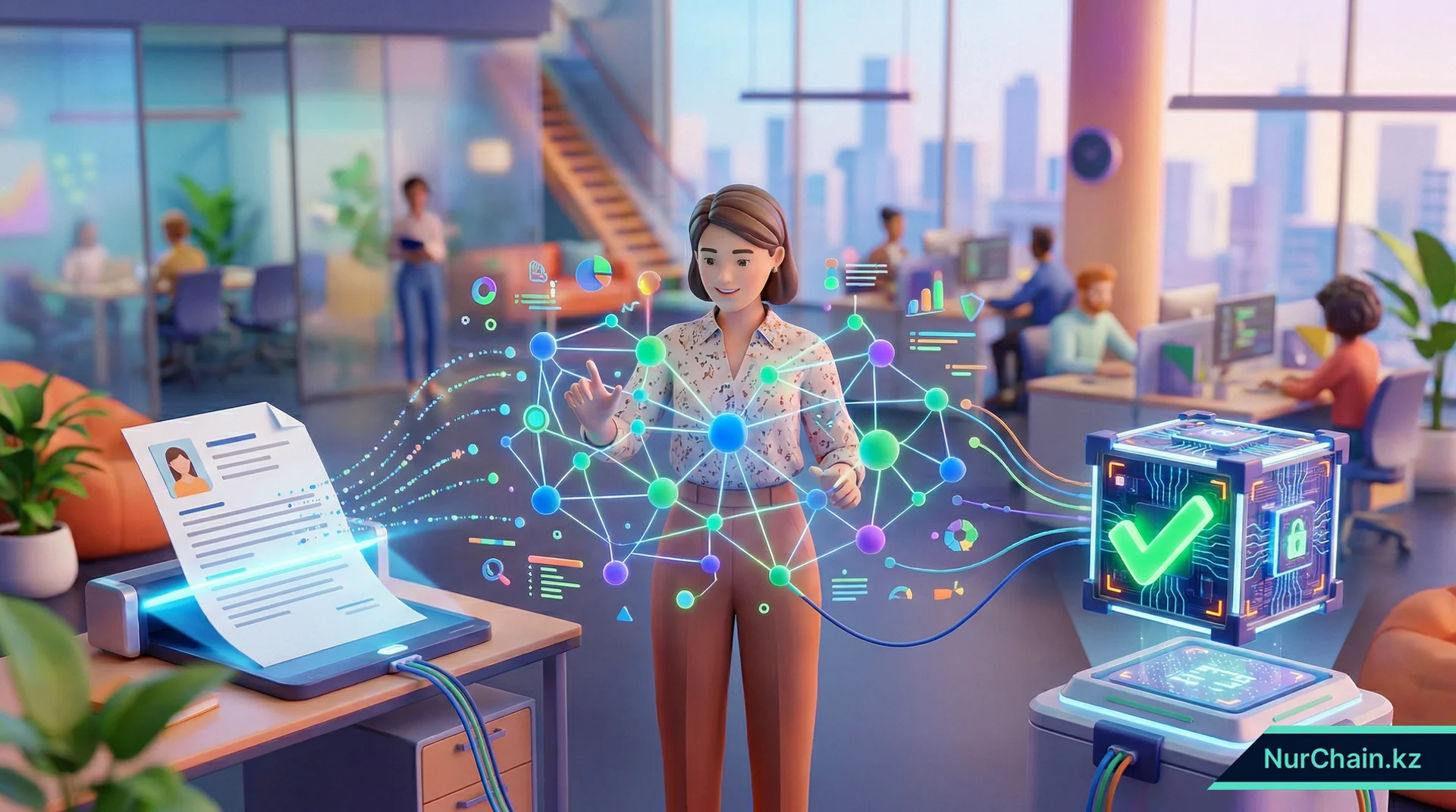
This is exactly where blockchain credential verification comes into play. Think of it as your strategic response to hiring fraud. We designed it to bring absolute integrity back to your recruitment process through unchangeable, decentralized records. By acting as a digital "source of truth," blockchain ensures accuracy so the person you interview is exactly who they claim to be. It effectively tears down those "digital walls" between you and verified talent. In this guide, we'll walk through the most pressing questions for HR leaders. We'll explore how this tech handles GDPR compliance and look at how digital wallets guarantee long-term record access. Finally, you’ll see why it delivers a massive ROI by slashing your verification costs and "time-to-hire."
🎓 This FAQ addresses the critical compliance and ROI concerns that form the strategic foundation of the Employers Guide to Verifying NFT Diplomas in Kazakhstan.
How Reliable Is Blockchain for Verifying Professional Credentials?
Have you ever felt a nagging doubt while reviewing a candidate’s CV (a detailed document highlighting their professional history)? You are certainly not alone. We’ve all been there-staring at a perfect resume and wondering if it is too good to be true. In an era where AI-assisted tools (software used to create or modify content) can manipulate documents in seconds, the challenge of spotting a fake or faked nft diploma has never been greater. To put it in perspective, reports from 2025 highlighted a staggering 244% year-over-year surge in digital document forgeries. According to a study by the Association of Certified Fraud Examiners (ACFE), nearly 40% of resumes contain some form of inflated or falsified information; this is a problem that traditional verification and legalization methods struggle to keep pace with in our digital-first world. Many leaders are now turning to blockchain credential verification as a way to restore integrity to the hiring process. This is exactly where blockchain steps in. Think of it not just as a buzzword, but as a digital "source of truth." By using decentralized ledgers (databases spread across multiple locations to ensure transparency), educational and professional data is recorded in a way that is completely immutable. This means that once a record is created, no one can manipulate a graduation date or a job title. Blockchain professional credentials ensure that the person you interview is exactly who they claim to be on paper.
The stakes of a bad hire are incredibly high. According to the U.S. Department of Labor, the cost of a "bad hire" can reach 30% of an employee's first-year salary. For specialized roles, that cost can easily exceed $120,000. Hiring fraud prevention has therefore become a top priority for modern talent acquisition teams. Blockchain helps you sidestep this financial landmine by replacing manual, weeks-long background checks with instant cryptographic verification in under 30 seconds. You might wonder, how does blockchain prevent resume fraud? It does so by creating a direct, unalterable link between the granting institution and the candidate’s digital profile. This shift toward digital diploma verification means you no longer have to wait for a university registrar to return your call. It is a powerful defense against the broader trend of fraud; the FTC reported that consumer fraud losses reached $12.5 billion in 2024 , with job scams ranking as a top threat. Modern blockchain background checks provide the real-time certainty needed in a fast-moving market.
Beyond that, new technologies like Zero-Knowledge Proofs (ZKPs) are a total game-changer for privacy. They allow you to verify that a candidate holds a "Master's degree" without you ever needing to see or store the sensitive underlying document, maintaining strict control over what data employers can see. This level of security is why the digital identity segment is expected to be the fastest-growing part of the blockchain market through 2030. Early adopters, such as the organizations highlighted in case studies of kazakhstani companies successfully using digital verification, are already seeing the benefits, with organizations reporting a reduction in hiring fraud by over 50% in just one year. That is a vital shield when you consider that deepfake biometric fraud was occurring at a rate of one every five minutes in 2024.
Quick Insight: Blockchain does not just store data; it anchors trust. In a world where AI can fake almost anything, having a tamper-proof "source of truth" is the only way to ensure your team is built on genuine talent rather than clever fabrications.

Is Blockchain-Based Credentialing Compliant with GDPR and Legal Standards?
Compliance is likely the first thing on your mind as an HR Director, and for good reason. You certainly don't want to face GDPR fines that can hit a painful 4% of your global annual revenue. Building a gdpr compliant blockchain hr strategy is essential for shielding your organization from these liabilities. Fortunately, modern blockchain solutions are shifting toward permissioned or private networks, which claimed over 42% of the market share in 2024. These networks are built specifically with regulations in mind and follow strict updates, like the April 2025 EDPB (European Data Protection Board) guidelines on processing personal data.
You might wonder about the "right to be forgotten"-the legal right for individuals to have their personal data deleted. It's a common concern that blockchain’s permanence might clash with privacy laws. Is blockchain compatible with GDPR's right to be forgotten? Absolutely, if you use the right architecture. By keeping sensitive personal information off-chain and only storing a hash on the ledger, you can delete the source data and effectively "forget" the individual while maintaining the integrity of the chain. Smart architects solve this by storing personal data off-chain on a private server outside the blockchain. Only a cryptographic hash-a digital fingerprint that reveals nothing about the actual data-stays on the ledger. This approach is winning over leadership; research by PwC and Deloitte found that 68% of CEOs believe blockchain’s transparency actually improves data privacy and auditability. This privacy-by-design architecture aligns with the EU’s eIDAS 2.0 regulation, which aims to provide citizens with a secure European Digital Identity Wallet by 2026. This ensures that cross-border credential verification of international degrees is both legally sound and user-centric. Maintaining high eIDAS 2.0 compliance standards ensures your digital credentials remain valid across all member states.
Beyond privacy, smart contracts can even automate your local labor law compliance. You can program smart contracts in recruitment to trigger specific actions, such as verifying work eligibility, only when certain conditions are met. This is a huge relief for the 30% of senior management who worry about complex regulations. Can blockchain automate labor law compliance? Yes-by embedding legal rules directly into the recruitment workflow, the system flags potential issues before they become violations. By using W3C standards for Verifiable Credentials (VCs) , you aren't just checking a box for today; you are building a scalable, future-proof framework that respects the EU AI Act and handles cross-border data transfers with ease.
Why It Matters: Think of blockchain not as a hurdle to compliance, but as a high-tech audit trail. It automates the "proof" of your due diligence, making the work of your legal and compliance teams significantly easier during an audit.

What Are the Long-Term Access and Longevity Guarantees for These Records?
You’ve likely seen it happen: a university closes or an employer goes bust, and suddenly, your professional history is trapped behind a dead link or a locked filing cabinet. This makes self-sovereign identity for employees more important than ever because it puts you back in control of your own data. It's a frustrating situation for everyone involved. Blockchain solves this by unlinking the record from the institution that originally issued it. This shift toward Self-Sovereign Identity (SSI) -where you control your digital identity without a central authority-is a major trend, backed by 170 million active cryptocurrency wallet users who already manage digital assets with ease.
This isn't just a niche project for a handful of schools. So, how do employees actually store blockchain-backed credentials? Most people use a secure digital identity wallet on their smartphones to carry their verified history wherever they go. The Global Blockchain Education market is on a massive upward trajectory, projected to hit $3.07 billion by 2030 with a 43.9% CAGR. Institutions like MIT and Harvard have already set the pace by issuing blockchain-backed diplomas. For you, this means your degrees and micro-credentials live in a personal Digital Wallet that you own forever.
This longevity is critical because the workforce is changing fast. Talent management technology must adapt to support a more mobile, skills-focused workforce. The World Economic Forum estimates that 50% of all employees will need reskilling by 2030 due to technological shifts. If you're looking into how to implement blockchain for professional certifications, start by issuing verifiable credentials HR can easily recognize across different platforms. In such a volatile market, having a portable, verifiable portfolio is essential. With 87% of companies reporting skill deficits, having a reliable way to track lifelong learning is no longer a luxury-it’s a necessity. It's no wonder that 91% of respondents in a 2025 Deloitte survey said they expect a clear, verifiable return on these digital record investments.
Takeaway: By giving employees ownership of their credentials, you support a "lifelong learning" culture. Their records stay with them through every career shift, ensuring your organization's skills data is always accurate and accessible.

What Is the Actual ROI and Cost-Efficiency for HR Departments?
Let’s get straight to the bottom line. How much time and money does your team waste on background checks right now? What are the cost benefits and top advantages of digital credential verification? You immediately cut out expensive verification fees and the hours wasted on manual follow-ups. When you add up fees-usually $50 to $200 per candidate-and the time spent chasing references, the costs spiral fast. Blockchain lets you slash these administrative costs by an incredible 90% by automating the entire verification layer (the part where you check for authenticity). You can easily demonstrate the blockchain hiring roi when you consider how many man-hours you reclaim for more strategic tasks.
The efficiency gains are just as impressive. IBM case studies show that blockchain can cut operational costs by 50% while boosting hiring efficiency by 80%. This is critical when you consider that the global blockchain market is set to surge past $67 billion by 2026. "By cutting out middlemen and manual verification, organizations can integrate nft diploma verification into hr ats systems and focus their energy on talent development," notes a Gartner Group analysis; this study highlights that blockchain-powered HR systems are now essential for the modern "composable" enterprise. If you check any hr blockchain faq, you’ll find that faster hiring is always a top benefit. For HR, this means moving away from "paper-pushing" and toward true talent management. Right now, managers spend about 17% of their time dealing with underperformers or fixing "bad hire" errors. What is the ROI of blockchain-based hiring systems? Beyond the hardware and software savings, the real value lies in higher-quality hires and the near-total elimination of credential fraud. By using a system that provides a 47% boost in operational efficiency, mid-to-large firms can recover the $30,000 per month usually lost to slow recruitment cycles. In a world facing an $11 trillion workforce skills gap by 2030, the ability to find, verify, and hire the right person instantly-or even perform batch verification for mass hiring campaigns -is a major competitive advantage.
Did You Know? The average company loses thousands of dollars every month simply because their hiring process is too slow. Switching to blockchain verification is like moving from snail mail to instant messaging-it changes the entire pace of your business.

Summary: Transforming Talent Acquisition with a Blockchain-Backed Foundation of Trust
Why does all of this matter for HR? Look at the big picture. You’re seeing a fundamental shift in the industry. We’re moving away from a world of reactive doubt. Now, you’re entering a time of proactive certainty in the hiring process. When you use blockchain for professional credentials , you aren't just adding another software tool. You're building a vital shield. This shield protects you from the rising tide of resume fraud and deepfake interference.
This foundation of immutable verification ensures your team is built on genuine talent. It’s a permanent, unalterable way to prove authenticity. Here is what this means for your budget. You can sidestep massive financial landmines. Think of "bad hires" that can cost your company over $120,000 for a single specialized role. The move toward Self-Sovereign Identity (SSI) is a total game-changer. This model gives individuals full control over their digital identities. Personal digital identity wallets make this possible. It empowers your employees to truly own their professional history. This helps you foster a culture of lifelong learning. That’s going to be essential. It helps you close that massive $11 trillion global skills gap everyone is talking about.
The best part? The transition is safe. It doesn’t have to cost you legal safety or your bottom line. We use "privacy-by-design" setups like Zero-Knowledge Proofs. These let you prove something is true without revealing the underlying data. We also use off-chain storage. Your organization stays fully GDPR and eIDAS 2.0 compliant this way. You're basically automating the most tedious parts of legal due diligence. Pair that regulatory peace of mind with a potential 90% reduction in admin costs. Add an 80% boost in hiring efficiency. Suddenly, the choice becomes pretty clear. Ultimately, blockchain helps you transform HR. It moves you away from manual paper-pushing. You become a streamlined, ROI-driven powerhouse . You can verify and onboard talent quickly. This matches the speed of the modern market.
🚀 Ready to see it in action? Now that you understand the theory and safety of the system, witness the speed for yourself by following the guide on How to Verify an NFT Diploma in Under 30 Seconds.
