The Synergy of AI and Blockchain in Higher Education
 Author:
 Reading time:
10 min
Reading time:
10 min
 Difficulty:
Easy
Difficulty:
Easy
Have you ever wondered why proving you actually earned your degree still feels so difficult? In our hyper-connected digital age, the process remains a bureaucratic nightmare. It feels like we're stuck in the last century. You find yourself staring at a static PDF resume, just hoping a recruiter takes your word for it. Meanwhile, universities are drowning in a sea of manual verification paperwork. This "digital wall" is real-it slows down careers and practically invites fraud . But what if your achievements were different? Imagine if they were as portable as a passport and as smart as a GPS.
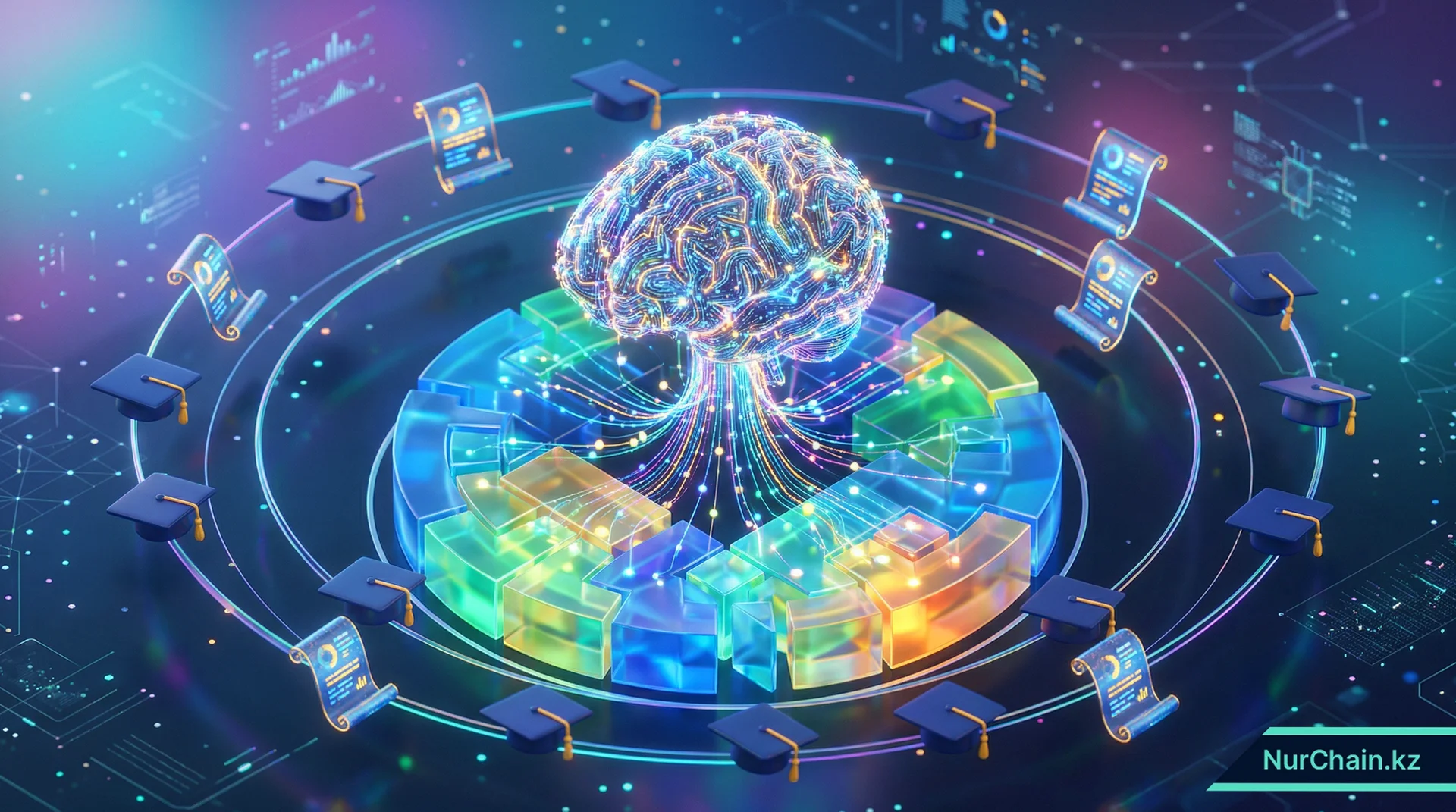
That is exactly where the synergy of AI and blockchain comes into play. Think of this partnership as a strategic response to the modern workforce challenge. It creates a secure, unalterable ledger of your skills that an AI can then use to map out your entire professional future. By merging the "trust layer" of a decentralized ledger with an "intelligence layer" of machine learning, we are moving toward a student-centric model where you truly own your data. This article explores how this powerful combination enables 100% verifiable academic records on the blockchain. It also powers AI-driven career mapping to close skill gaps and builds a "live digital resume." This dynamic, real-time record of your qualifications opens doors to global mobility and personalized lifelong learning.
🎓 The integration of artificial intelligence and distributed ledgers represents a core technological pillar in the future of edtech in kazakhstan beyond digital diplomas.
How Can AI Leverage Verifiable On-Chain Data for Career Mapping?
How much easier would your job hunting be if your resume could actually prove itself? Standing out in a sea of candidates is tough, but integrating blockchain technology into your academic journey gives you a 100% verifiable record of every achievement you earn. This intersection of AI and blockchain in higher education isn't just about security; it’s about your empowerment. You might ask: why is blockchain important for verifiable academic records? It’s because the technology prevents tampering, ensuring your credentials remain trustworthy forever. This is more than just a niche trend for tech enthusiasts. Market research projects that the global blockchain education market will skyrocket to $22.31 billion by 2035, growing at a steady 25.01% CAGR. As the European Commission’s Joint Research Centre (JRC) highlights, these technologies build a foundation for lifelong learning records that move with you across borders. When you feed this clean, unalterable data into an AI, your career planning truly starts to transform.
Think of it as a helpful GPS for your professional life. This foundation makes AI-driven career mapping possible, allowing for a hyper-accurate skill gap analysis based on your real achievements. An AI can analyze your unique NFT-based diploma and specific skill badges to pinpoint exactly where you stand. So, how can AI leverage blockchain data for your career? By scanning your NFT-based diplomas and degrees, the AI understands your full expertise instantly. This matters more than ever because 36% of EdTech funding now flows directly into workforce training and upskilling. The AI doesn't just look at what you’ve done in the past; instead, it identifies "skill gaps"-the distance between your current abilities and those needed for specific roles-by comparing your verified achievements against millions of successful career paths. In a global economy where AI will likely shift the requirements for 85% of all jobs by 2030, having a data-driven roadmap is a massive advantage. Can AI identify skill gaps using blockchain-verified data? Absolutely-and it does so with surgical precision.
What’s more, this synergy creates a "Live Digital Resume." Instead of a static PDF sitting on your hard drive, you get a dynamic profile that an AI continuously updates as you gain new, verifiable credentials. For universities, the benefits are just as clear. Recent institutional studies show that adopting this model can reduce verification time by 47% and slash fraud-related administrative costs by an average of 71.4% per institution.
Quick Insight: A blockchain-backed resume acts as your "single source of truth." By letting AI map your skills against real-world demands, you stop guessing your next career move and start executing a strategy backed by hard data .

Why Is This Combination the Future of Personalized Education?
Why should you follow the exact same path as everyone else when your goals are so unique? We’ve all felt the frustration of a "one-size-fits-all" curriculum, but combining AI and blockchain is finally making truly personalized, decentralized education a reality. This creates personalized education pathways that adjust to your progress in real-time. We’re seeing a unique synergy of AI and blockchain in EdTech that makes the very infrastructure more resilient. Right now, 86% of students use AI tools in their daily studies. But the real magic happens when those tools link to a secure, student-centric model of data ownership. By prioritizing decentralized identity in education, we make sure data ownership and privacy stay in your hands. This shift toward decentralized identity -a framework where you control your own credentials-is backed by Gartner's forecast that blockchain’s business value will top $3.1 trillion by 2030 , driven by better transparency and trust in digital ecosystems.
In this new setup, you’ll use a personal digital wallet to hold your verified skills and competencies (your specific practical abilities). What exactly is the synergy between AI and blockchain in education? It’s the power of a secure record meeting an intelligent engine that knows how to use it. This fits perfectly with the global digital badge market, now valued at $590 million and growing at a 16.9% CAGR. This momentum is driving massive digital badge market growth as learners hunt for stackable achievements. When AI scans these wallets, it can provide perfectly tailored career recommendations based on your unique "educational DNA." We’re also seeing the rise of Smart Contracts -self-executing digital agreements-bridge the gap between learning and landing a job. How do smart contracts improve personalized learning? They power smart contracts for micro-courses, automatically checking your prerequisites so you never stop moving. Imagine AI spotting your dream career path and a smart contract instantly unlocking the exact micro-courses you need to get there.
This isn’t just theory; pilot programs using this automated approach already show a 57.2% jump in administrative efficiency . Beyond speed, the security perks are massive. Research shows that blockchain-based records slash security incidents by 76% and cut storage costs by 49%. How does decentralized identity empower student data ownership? It hands you a digital passport that no institution can take away. It turns you from a bystander into the active data owner of your own future.
Takeaway: Personalized education is becoming the new standard. When your achievements live on-chain, AI acts as your lifelong personal tutor and career coach, keeping your skills relevant forever.

What Are the Real-World Benefits of AI and Blockchain Synergy?
Once you cut through the technical jargon, what does this actually mean for you as a university leader or hiring manager? Having verifiable on-chain data means a student's hard work is truly portable. The practical impact is massive. Hiring paperwork is often a nightmare, but leading schools now cut up to 90% of administrative overhead-the heavy costs of managing paperwork-by automating the candidate-matching process. This gives administrative efficiency in universities a huge boost through automated credential verification. A mid-sized university can save roughly 1,240 staff hours every year-time you can reinvest into actually supporting your students. So, what are the real-world benefits of AI and blockchain for universities? It’s mostly about building an academic fraud prevention system that never sleeps. If you’re a student, your biggest win is unprecedented global mobility, letting you move and work abroad with ease.
In the old system, proving your degree to an employer in another country is a slow, expensive nightmare. Now, AI-driven platforms can instantly translate your on-chain credentials into international contexts. By using a zero-trust verification model based on global digital credential standards, employers can trust instant digital resume verification. This is a vital shield in a world where the market for cross-border fraud detection will likely hit $54.6 billion by 2025 . The World Economic Forum calls this a key part of the "Reskilling Revolution," where digital credentials act as a universal language for a changing workforce.
This infrastructure is the ultimate backbone for Lifelong Learning . It also powers micro-credentials and upskilling, giving you better global mobility for graduates who want to work across borders. Since 41% of modern employers now prioritize blockchain-verified micro-credentials, you need a way to track your growth over decades. Employers can finally use a "Zero-Trust" verification model (where every user is validated first), which means they don’t have to spend weeks on manual background checks. People often ask: is a blockchain-backed resume better than a traditional PDF? The answer is a hard yes, because it’s impossible to fake and is instantly machine-readable . This is a massive win for the economy, especially since academic fraud costs the global market over $22 billion every year. By using AI to audit blockchain records, we aren't just speeding up hiring-we're making it honest.
Why It Matters: This combo creates a trust layer for the entire world. It protects your hard-earned degree and ensures the right person gets the job without the friction of old-school bureaucracy.

Summary: Building a Trust-Based Future for Lifelong Learning and Career Success
What’s the big takeaway? The fusion of AI and blockchain marks a fundamental shift in how we value, track, and actually use educational achievements. At its core, this synergy fixes the "trust gap" in the labor market. It provides a 100% verifiable record of your progress. This includes every diploma, certificate, and skill badge you've ever earned.
Institutions can virtually wipe out academic fraud by moving credentials onto a decentralized ledger. This is a massive problem. Fraud currently costs the global market over $22 billion every year. On top of that, this shift slashes administrative overhead and cuts verification times by nearly half. It creates a single source of truth . This is a win-win that benefits both the graduate and the employer. It ensures your hard-earned qualifications are recognized instantly. They’ll be respected no matter where in the world you are.
The true power of this collaboration is even more exciting. It transforms a static record into a dynamic career strategy. The AI has access to clean, on-chain data. This is information stored directly within a blockchain network. Because of this, AI-driven career mapping can perform a surgical "skill gap analysis." This is simply the process of identifying the difference between your skills and job requirements. In simple terms, it compares your unique NFT-based degrees against real-world market demands. This gives you a hyper-personalized education pathway. It allows you to build a "Live Digital Resume." It evolves in real-time as you gain new micro-credentials. We are prioritizing decentralized identity and student-centric data ownership. By doing this, the model empowers you to navigate a changing global economy. Experts say 85% of jobs will shift by 2030. Ultimately, the combination of AI and blockchain does more than just increase efficiency, aligning with the 10-year roadmap for digital education. It democratizes opportunity. It ensures your verified expertise is the only passport you need to succeed.
🚀 Ready to see the long-term vision? Now that you understand how AI and blockchain work together to verify skills, discover the strategic milestones for the next decade in a 10-year roadmap for digital education in kazakhstan 2025-2035.
